 Alexander wan2ted Evsin
In February 2026 a group of students posted about a crash in a rented car near Tbilisi. They had done the right thing at the scene: the patrol police came, wrote it up, handed them a 250 GEL fine. Then the car's owner told them to keep the police out of it from here on, checked a nearby hotel's cameras instead, and asked them for about 8,000 dollars.
The sub answered in one line.
Anyone saying "don't get the police involved" does not have your best interest in mind.
u/Pack-Worldly, r/tbilisi
Every rental accident in Georgia splits into two outcomes that are decided in the first thirty minutes, before anyone knows how bad the damage is. Either there is a police report and the insurer pays, or there is no report and the bill lands on the person holding the keys.
What to do first after an accident in a rental car
Stop where it happened, hazards on, call 112 and wait for the patrol police: without a report the insurer refuses the claim. Then call the rental company and the insurer, before anything is towed or repaired. Tyres, wheels and the restricted mountain roads sit outside the cover in any case, which is where the deposit guide picks the story up.
The first thirty minutes
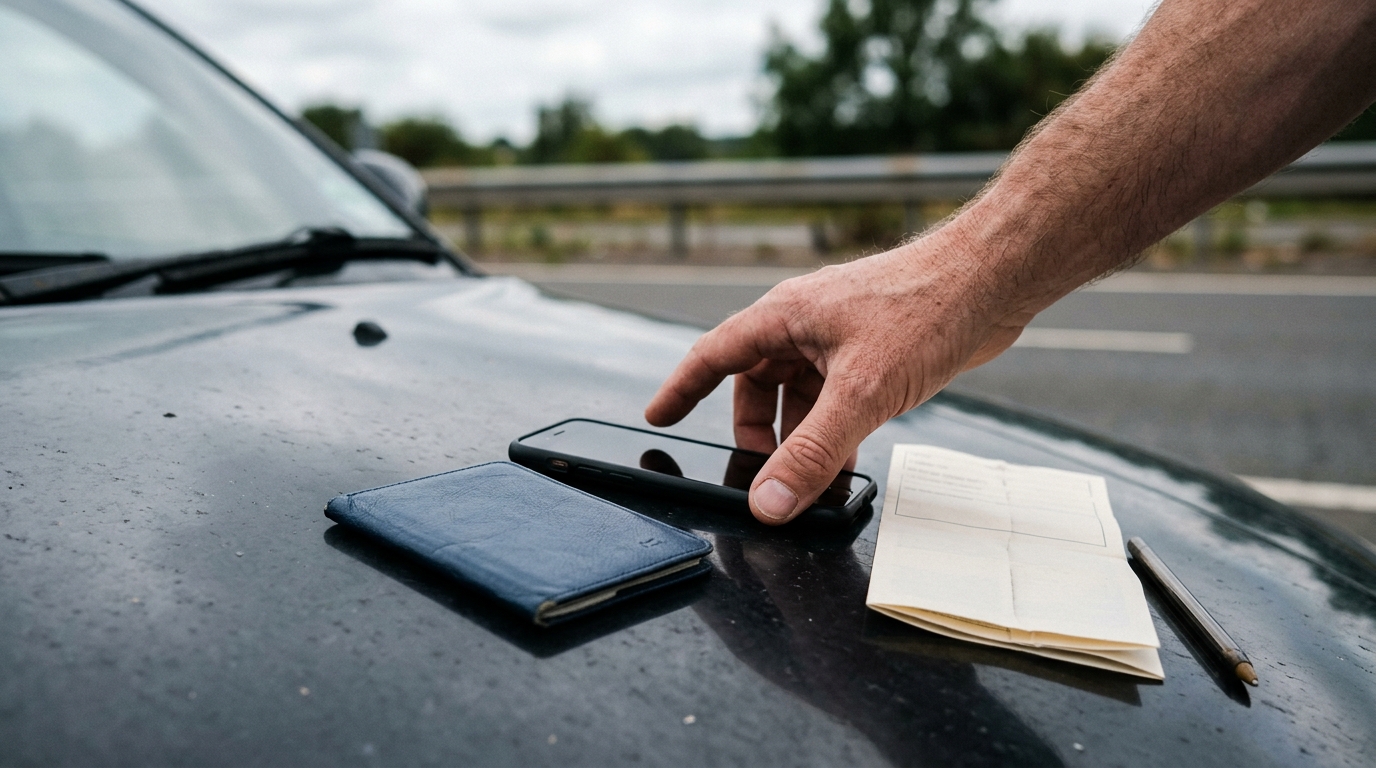
Georgian traffic law is unusually specific here. Under the Law on Road Traffic, a driver in an accident must "stop the vehicle immediately (not drive away), and switch on hazard warning lights", check that nobody is hurt, "notify immediately an authorised agency within the Ministry of Internal Affairs of Georgia", stay at the scene until an officer arrives, change nothing and write down the names of witnesses.
In order, and none of it is optional:
- Stop where it happened. Moving the car to a convenient spot destroys the scene and, under a standard rental contract, moves the whole bill to you. The contract language is blunt: after any damage the renter must not move the vehicle, must contact the lessor and the insurer, and must follow their instructions.
- Hazards on, then check people. An accident under Georgian law includes damage to property with nobody hurt, so a scraped bumper is still an accident.
- Call 112. Ask for the patrol police and say where you are. This call is what turns the crash into an insurable event. If anyone is hurt, the same number brings the ambulance, and the law obliges you to give first aid and, in an emergency, to get the injured to the nearest hospital by any means available.
- Call the rental company. A standard contract requires the renter to notify the lessor immediately and to follow the instructions the lessor and the insurer give.
- Call the insurer. The rental company will usually do this with you; the policy expects the accident on their hotline too.
- Photograph everything before the car moves. The list is below, and it takes two minutes.
There is one shortcut in the law, and it is narrow: if nobody is injured, the drivers may agree a scheme of the accident between themselves, sign it, and then go to the nearest patrol police subdivision to register the fact. That still ends at a police desk. It is not a way to skip the report.
The cost of doing it properly is visible in the thread above. The police fine for the manoeuvre was 250 GEL. The demand that arrived after the police were kept out of it was thirty times larger.
The worst thing that could happen with the police's involvement is 250 GEL fine, which you already got
u/zpavliashvili, r/tbilisi
The rule that turns a victim into an offender
The instruction to stay put is not a formality, and the way it fails is not obvious. A German visitor driving a rental car in Tbilisi was hit by another driver who did not stop. He did what most people would do: he followed the car to get the plate. By the time the police finished, they were talking about revoking his licence.
Because I was following the other driver. Under georgian law they they told me this is hit and run because I didn't stay at the place where the accident happened.
u/kjf52, r/Sakartvelo
The scratch itself was minor. The evening was five hours long. A local commenter in the same thread laid out what he should have done instead, and it is the shortest correct answer anyone has written on the subject:
stay at the place of accident and start the hazard lights. write down the car number that hit you and try to get at least two witnesses who can repeat your story. (Or get a good quality dash cam)
comment in the thread, r/Sakartvelo
The plate is enough. Chasing it is what costs you the case, because the moment your car leaves the scene, the paperwork stops describing you as the injured party.
The three calls, and what each one needs
112 is the emergency number for police, ambulance and fire. Say the city or the road and the kilometre if you are outside town, say whether anyone is hurt, and stay on the line until they confirm a patrol is coming. Operators work in Georgian, Russian and English.
The rental company needs the same facts plus your contract number, and this call is the one that decides how the rest of the week goes. A serious operator will tell you what the insurer wants, whether to wait for an assessor, and who arranges recovery. Under a standard contract, acting without those instructions moves liability to the renter.
The insurer logs the claim. The report number from the police is what they open the file with, so this call usually goes after the patrol has arrived, not before, unless the rental company tells you otherwise.
There is a fourth number worth knowing and hopefully never using. If a patrol officer behaves in a way that looks wrong, the Ministry's General Inspection line is 126, and locals treat it as the police of the police:
Next time call 126 - Hotline for General Inspection. And watch how these "policemen" shit their pants :) It's a way to report something when you don't like the attitude or actions by the police.
u/NebSkywalker, r/Sakartvelo
If you are a foreign national, your embassy is a legitimate second call in a situation that turns serious.
What to photograph before anything moves
Two minutes of phone work is what stands between you and a dispute you cannot win later. Shoot, in this order:
- the whole scene from four sides, far enough back that the road, the markings and the traffic lights are in frame;
- both cars where they stopped, including the gap between them;
- both number plates, sharp and readable;
- every point of contact, close up, with something for scale;
- the other driver's licence, registration and insurance paper;
- the road surface: gravel, ice, a pothole, a missing sign;
- anything that will be gone in an hour, like a broken pallet or a stray animal.
Then write down the names and phone numbers of two witnesses. Both the law and the local advice converge on the same point: witnesses who can repeat your version are worth more than an argument at the roadside, and a dash cam is worth more than both.
Keep the handover video the rental company shot when they gave you the car. Standard contracts record the vehicle's condition on video at handover and describe it again on return, and that pair of recordings is what settles which damage is yours.
The scheme of the accident: Georgia's europrotocol
The law allows drivers to settle the paperwork between themselves when nobody is injured. In practice it works like this: the drivers agree what happened, draw the scene on paper, both sign it, and then take it to the nearest patrol police subdivision to register the fact. That registration is the point of the exercise, and skipping it means there is no report at all.
The scheme should carry the date, time and place, both plates, both licence numbers, the direction each car was travelling, the position of the cars after the impact, the traffic signs and markings around them, and a plain sentence about who did what. Photograph the signed sheet before you separate.
Two caveats matter more here than anywhere else in this article. First, a rental car is not really yours to settle for: standard contracts require the lessor's instructions before you agree anything, and an unauthorised settlement can leave the damage on you. Second, if there is any doubt about injuries, the option is off the table entirely.
The cow on the road
Livestock on Georgian roads is a routine hazard rather than a curiosity, and the law has a clause for it. If an animal is hit while it was unattended and grazing or being driven in breach of the rules, the driver "shall be released from the liability to compensate for any damage incurred as a result of the injury or death of the animal".
The duties on the other side are spelled out in the same law. Cattle must be driven along the edge of the carriageway in one line, in daylight as a rule, never left on the road unattended, and not driven along asphalt roads where another road exists. Herds crossing a carriageway are split into groups with 80 to 100 metres between them.
Read that carefully, because it answers only half the question. The law frees you from paying for the animal. It says nothing about who pays for the car, and that half is settled by the rental contract and the insurance policy, which means the same three calls: 112, the rental company, the insurer. A cow is a traffic accident like any other, and an unreported one is an uninsured one.
The practical shape of the risk is dusk and dawn on a mountain road, an animal the colour of the asphalt, and a driver going the speed the road allows rather than the speed the corner allows. Braking hard is not always the right answer either: the law bans hard braking except to prevent an accident, and on a wet mountain road a swerve into the opposite lane is the more expensive mistake. Slow down on the approach to villages, and expect the second and third animal after the first one.
The trap is geography. The regions where cattle wander onto the road at dusk are the mountain regions, and mountain regions are where rental cover stops.
Where the map decides who pays
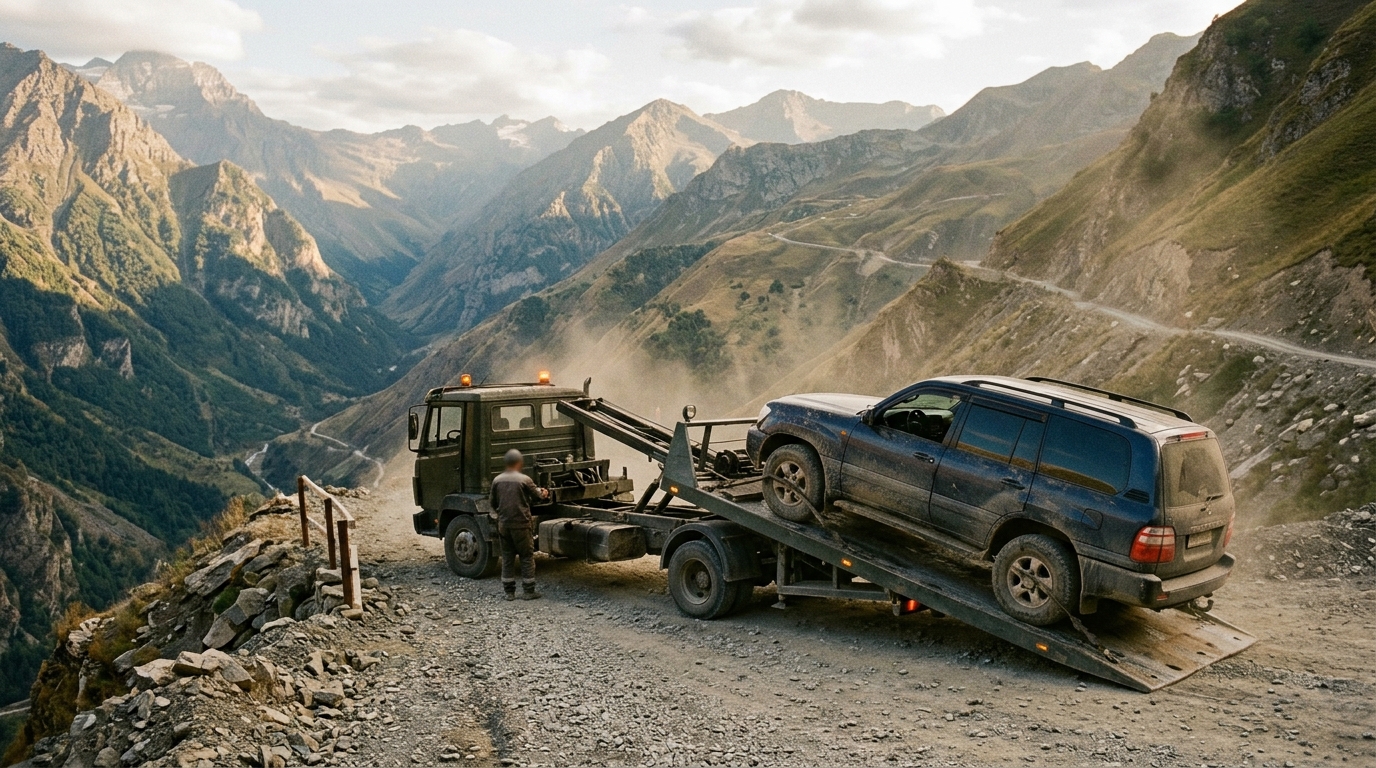
A standard Georgian rental contract names the roads its insurer will not follow you onto. In this one they are Tusheti, the Goderdzi Pass, Svaneti and Khevsureti. Leaving the agreed route is priced separately from any damage: a 1,000 dollar penalty, and the contract also lets the lessor disable the car, terminate the rental, send a driver to recover it and keep both the rent and the deposit.
Renters compare notes on roughly the same list:
Yeah, just ask them. I've rented much less capable 4x4s (not even true offroaders), and the only forbidden roads were Tusheti, Akhaltsikhe-Khulo and Lentehi-Ushguli
u/agathis, r/Sakartvelo
What that looks like when it goes wrong:
My friends rented a car and went to Mestia region. They drove through some puddle and punctured the bottom of the car in a very unfortunate way. They had to spend the evening at the police, take a drive in a tow truck back to Zugdidi and pay about $2000 for repairs.
u/Lladyjane, r/Sakartvelo
Note what they still did right: the evening at the police station. Note what did not help: the underbody is not the sort of damage a road policy covers, and the tow was theirs to pay for.
If the route includes gravel or a pass, that has to be agreed before departure and written into the contract, not decided at a junction. The off-road routes guide covers which of them a rental car can legitimately take.
What voids the insurance
Rental policies in Georgia are written as a list of refusal conditions, and they are worth reading before signing rather than after a crash. A standard contract annex allows the insurer to refuse payment in these cases:
| Situation | Result |
|---|---|
| The accident was not reported to the police via 112, with a report drawn up | Refused |
| The accident was not reported to the insurer's hotline | Refused |
| The accident was not reported to the rental company's hotline | Refused |
| Driving under the influence of alcohol or drugs | Refused |
| Driving in the oncoming lane, or passing a red light | Refused |
| Damage caused deliberately rather than by accident | Refused |
| The car was moved, repaired or towed before the insurer's instructions | Liability moves to the renter |
| Belongings of passengers, or property inside the car, damaged in the crash | Not covered at all |
The first three lines are the ones that catch tourists. They are also the three that cost nothing to satisfy: three phone calls from the roadside.
One more line deserves attention because it is easy to trigger by accident rather than by intent. Handing the wheel to someone who is not on the contract voids the arrangement as surely as a missing report. Standard contracts forbid passing the car to third parties at all, and specifically to anyone under 21 or with less than a year of driving experience, while the renter themselves warrants at least twelve months behind the wheel.
What sits outside the cover even with a perfect report
A police report protects you from the largest bills. It does not make the rental free of consequences, and a standard contract prices the rest of it:
| Item | Who pays |
|---|---|
| Tyre or wheel damage | Fixed penalties in the contract, typically 1,000 dollars for a tyre and 2,000 for a wheel |
| Days the car spends off the road | The renter, at 300 GEL per idle day until it is back in its original condition |
| Third-party damage above the policy limit | The renter. The liability limit in this contract is 5,000 dollars |
| Items inside the car, and passengers' belongings | Nobody. Explicitly excluded |
| Traffic fines during the rental | The renter, checked afterwards at videos.police.ge |
| Lost key, lost registration document | 1,000 dollars and 150 dollars respectively |
| Interior damage, burns, heavy soiling | 1,500 dollars for damage, 250 for cleaning |
| Total loss, insurer pays | The renter, a 9,000 dollar penalty under the contract |
| Total loss, insurer refuses | The renter, the market value of the car plus the same 9,000 |
| Damage from drifting or off-roading | 20,000 dollars, because that use sits outside the contract |
The tyre and wheel lines are worth a moment. They are the most common damage on Georgian roads and the least insured anywhere in the country, which is why the deposit article treats them as the real risk rather than the deposit sum itself.
Those last three lines are the reason the first thirty minutes matter so much. A police report is what keeps a write-off inside the insurance rather than outside it, and the gap between the two total-loss rows is the price of the car itself. The drift line is a different animal: it is not an accident clause but a use clause, aimed at the same behaviour that puts a rental on Tusheti gravel or into an empty car park at night, and it applies whether or not the insurer would otherwise have paid.
When the other driver is at fault, or already gone
Georgian rental policies typically cover damage caused by a third party as well as your own, which is why the report matters even when the crash is obviously not your doing. Without it you are asking an insurer to pay for a version of events that exists only in your telling.
Two things are worth knowing about how fault gets decided here. Street cameras are not everywhere, and the ones that exist are not always recording. One Tbilisi driver was hit by a car reversing into him, watched the other side privately admit fault to the officer, and still ended up with the 250 GEL fine himself:
I did appeal but unfortunately all the cameras that we had on Chavchavadze back then, were apparently turned off.
u/Galakt0s, r/Sakartvelo
That is the argument for a dash cam in a country where a rented car costs you nothing to equip and where a suction mount and a 30 dollar camera settle disputes that cameras on poles will not.
If the other driver leaves the scene, stay where you are, photograph the plate if you got it, find witnesses, and let the police work. The pursuit is the one move that converts you from complainant to suspect.
After you hand the keys back
The rental does not end when you park the car. The contract describes the vehicle's condition on return and compares it to the handover recording, and anything new becomes a claim. If the car needs repair, the idle-day charge runs until it is back in its original condition, which is why a small dent that waits three weeks for a part can cost more in downtime than in bodywork.
Fines are the other tail. Camera fines arrive days or weeks later, they are the renter's under the contract, and they surface at videos.police.ge by plate. Check the site before you leave the country and again a couple of weeks after, because an unpaid fine also carries a late-payment charge under standard rental terms.
Keep everything: the report number, the photographs, the handover video, the correspondence. A claim that is settled in a week for one renter takes a month for another, and the difference is almost always the paperwork.
The honest caveat
None of this makes the rental company your opponent. A serious operator wants the police report as much as you do, because without it the insurer refuses their claim too, and the day ends with two parties arguing over the same damage. The contract even says so in its own words: call the company first so they can walk you through the police and the insurer.
The operators to worry about are the ones asking you to keep this quiet. That request is not a favour. It means the damage is about to be settled between you and them, with nobody to appeal to, which is exactly the position those students found themselves in.
And a caveat about the advice itself: plenty of drivers here settle small knocks privately and never think about it again. That works right up until the car is not yours. On a rental, a private settlement leaves you carrying a contract you have already breached, with no report, no claim and no argument.
Frequently asked
What is the first thing to do after an accident in a rental car in Georgia? Stop, do not move the car, hazards on, call 112. The police report is what makes the insurance work.
Do I have to call the police for a small scratch? Yes. Under Georgian law an accident includes property damage with nobody hurt, and an unreported one is uninsured.
Can we just exchange details and settle it ourselves? Only in part. If nobody is injured, the drivers may agree and sign a scheme of the accident, but they still have to register it at the nearest patrol police subdivision, and on a rental car the lessor has to authorise it.
Someone hit me and drove off. Should I follow them? No. Leaving the scene makes you the one who left the scene, whatever happened first. Photograph the plate, keep witnesses, call 112.
Who pays if I hit a cow in Georgia? The law releases the driver from paying for an animal that was unattended and grazing in breach of the rules. Damage to the car is a separate question, settled by the contract and the insurer, so report it like any accident.
Is a rental car insured in Svaneti or Tusheti? Usually not. Standard contracts name Tusheti, the Goderdzi Pass, Svaneti and Khevsureti as excluded, and leaving the agreed route carries its own penalty on top of the damage.
Are tyres and wheels covered? Almost never. Contracts price them separately, in the region of 1,000 dollars for a tyre and 2,000 for a wheel.
What happens if the car is written off? The contract sets a 9,000 dollar penalty on top of the insurance payout. If the insurer refuses the claim, the renter owes the market value of the car as well, which is why the police report decides the size of the bill.
Is drifting really a 20,000 dollar clause? Yes, and it covers off-road use too. It is a use clause rather than an accident clause, so it stands on its own regardless of what the insurer decides.
Can my friend drive the rental car? Only if the contract says so. Standard terms forbid handing the car to third parties, and specifically to anyone under 21 or with less than a year of licence.
Who pays the fine the police issue at the scene? The renter. All fines issued during the rental period are the renter's, and unpaid ones surface later at videos.police.ge.
What if the patrol officer gets it wrong? The fine can be appealed, and the Ministry's General Inspection line, 126, exists for complaints about how officers behave. If you are a foreign national, your embassy is a reasonable second call.
The rental company says not to involve the police. What now? Involve them anyway and put the request in writing. Every refusal condition in a rental policy starts with the absence of a police report.
An accident abroad feels like the moment control disappears. In Georgia it is the opposite: the rules are written down, the number is 112, and the difference between a 250 GEL fine and a four-figure demand is three phone calls made from the roadside.
Before the trip, read the insurance annex of whatever contract you are signing, and ask which roads are excluded. For a car with the cover, the route and the concierge already agreed in advance, the fleet and a fifteen-minute answer are the shorter path.