 Alexander wan2ted Evsin
Open ten Georgian car rental sites and nine of them lead with the same three words. No deposit required.
It works, because it removes the thing travellers dread most: a stranger holding several hundred dollars of their money for a week in a country where they do not speak the language. What almost none of those pages put on the same screen is the excess, often called the franchise, which is the slice of any damage bill you pay out of your own pocket before the insurance starts working.
Those two numbers trade against each other, and at least one Georgian operator publishes the exchange rate openly. GoDrive lists a "0 deposit and 0 franchise" option on its Georgian rental pages and states that choosing it increases the rental price by 65%. That is what a released hold costs once somebody puts a figure on it.
We run a fleet in Tbilisi and have this conversation on WhatsApp several times a week. Below is the whole mechanism, with the numbers this market actually publishes.

Quick answer
A car rental deposit in Georgia is a refundable security amount, either blocked on your card or taken in cash, and returned when the car comes back undamaged. Local companies commonly hold $100 to $300. International desks hold far more. The deposit comes back. The excess is the part of a damage bill you pay yourself, and that number sets your real exposure. Read both before you sign, together with your insurance position and, in winter, the tyre rules on mountain routes.
How big is the hold, really?
Start with a company that publishes the figure. National's Tbilisi location page states: "The deposit is 500 USD for the categories Mini, Economy, Compact Intermediate and Standard and 600 USD for the categories SUVs, People Carrier and Premium." That is on National's own Georgian page, for an economy hatchback.
Local operators sit an order of magnitude below that. The comparison platform Helper puts the market at "$100-200 for local companies, and +/- $1000 for international companies". A Georgian rental blog reviewing the local field describes the same split: international brands ask for a credit card and block 500 to 1,000 USD, while local companies take 200 to 300 USD or nothing at all, refunded in cash at handback. Our competitor WeRent claims a wider band still, with airport desks blocking €500 to €1,000 on an economy car and €1,500 to €2,000 or more on an SUV; treat that as an industry claim from an interested party, and check the figure on the contract in front of you.
The Georgian-language market runs on lari and is just as varied. Geo Rent Car's terms page requires a security deposit of 500 GEL. Car Rent Georgia asks for 100 GEL and a minimum age of 24.
Three conclusions travel well from those numbers. The hold scales with the car, not with the length of the rental. It scales harder with the company's size. And it is temporary in every one of those contracts.
The excess is the number that decides your exposure
A deposit is a hold. An excess is a loss.
Every Georgian rental you will be offered includes CASCO on the car and OSAGO on your liability to other people. CASCO almost always carries an excess, and that excess is the first slice of any repair bill, payable by you regardless of the deposit you left. WeRent's own guide puts the typical figure at "€800-2,000" across many Georgian desks and says a zero excess upgrade runs €20 to €40 a day at international counters.
Now put the two together. A €0 deposit with a €1,500 excess leaves you exposed to €1,500. A $500 deposit with a $0 excess leaves you exposed to nothing beyond the inconvenience of a blocked card for a few days. The headline that sells better is the first one.

The deposit is the money they hold. The excess is the money you lose. Only one of those two is printed on the landing page.
What zero deposit actually costs
The clearest data point in this market is public and specific. GoDrive's Georgian no-deposit page describes a "0 deposit and 0 franchise" option selected at booking, states plainly that the rental price rises by 65%, and lists what the option still does not cover: fines, fuel differences, late returns, lost keys and lost documents.
Sixty-five percent is the excess, converted into daily rate and spread across the booking. Someone still carries the risk of a €1,500 repair, and the pricing decides whether that someone is you, in one frightening moment, or all of the operator's customers, a little at a time.
That reframes the market's favourite headline. A zero-deposit rate is a bundled insurance product with the premium folded into the day rate. When the markup is named as a number, the customer can compare. When it is not, the customer assumes the risk vanished.
| Rental shape | Typical hold | Typical excess | Card needed | What you actually risk |
|---|---|---|---|---|
| International desk, airport | $500 economy, $600 SUV (National Tbilisi) | Standard CASCO excess unless you buy it down, roughly €20-40/day at the counter per WeRent | Credit card in the main driver's name is often required, per Wander-Lush | The excess, plus a large blocked balance for the trip |
| Local company, standard cover | $100-300, often cash (Helper) | Named in the contract, frequently unstated online | Debit or cash usually accepted | The excess, on a smaller hold |
| Zero deposit, zero excess option | $0 | $0 | Card for the rental payment | Fines, fuel, late return, lost keys, at +65% on the rate (GoDrive) |
| Genuine no-deposit no-franchise operator | $0 | $0 stated in writing (Georgia On Wheels) | No prepayment required | Whatever the contract excludes; read the exclusions |
| Premium concierge (our model) | Set per car, confirmed before delivery | Zero for verified guests, published on each car page | Discussed with the concierge | The exclusions only |
The exclusions that turn an excess into a full bill
An excess caps your loss only inside the situations the policy covers. Georgian contracts routinely carve out the parts of a car that Georgian roads damage most.
Helper's own market summary is blunt: "insurance with a deductible does not cover damage to wheels, mirrors, glass and body, but full super CASCO has full coverage". WeRent lists the same short list of usual exclusions: windshield and glass, mirrors, tyres and wheels, the underbody. Anyone who has driven the gravel on the way to a monastery knows which of those items is most likely to need replacing.
Territory is the second carve-out, and it is the expensive one. A traveller in r/tbilisi described being told that his rental could not be taken into Tusheti "because of the dangerous terrain or heavy off-road situations for insurance reasons". Drive somewhere the contract forbids and the excess stops being a cap. The whole value of the car becomes yours.
Ask these three questions before the keys change hands
1. What is the excess on this car, in numbers, and is it written in the contract?
2. Which parts are excluded from cover: glass, mirrors, tyres, wheels, underbody?
3. Which roads or regions are off limits, and does that include Tusheti,
   Omalo, Shatili, Ushguli or any unpaved section of my route?
Send that as a message before you book. An operator who answers all three in writing within minutes is telling you something useful about how the return inspection will go.
The five-minute handover that ends the argument
The most common bad ending in this market has nothing to do with deposits. It is a disputed scratch at handback: nobody remembers the mark, neither side has proof, and whoever has the better paperwork wins.
The gap between the two scenarios shows up in ordinary rental threads. In a June 2026 thread on r/Sakartvelo asking for rental recommendations, the poster asks for a company "without crazy deposits", and one reply describes the good version: handback took under five minutes, with the agent waiting outside the office on the street. A fast handback is always a consequence of the car's condition being recorded at pickup.

The routine below takes five minutes and converts that argument into a comparison of timestamps.
- Video first, then stills. Walk a slow lap of the car with video running before you touch anything. Then photograph each corner, both bumpers, all four wheels and the windscreen up close.
- Photograph every mark you find, including the ones the agent waves off as nothing. A mark that is invisible in the shade is very visible under a workshop light two weeks later.
- Shoot the interior, seats and boot included, plus the roof lining if you are collecting an SUV that has carried skis.
- Capture the fuel gauge and the odometer in one frame. Fuel level disputes are the second most common return argument and the easiest to end.
- Make sure the existing damage is written on the handover sheet, not merely acknowledged verbally, and photograph the signed sheet.
- Repeat the whole lap at handback, in the same order, before the agent walks away.
Six phone photos and one video, taken at pickup, have settled every ambiguous return we have handled. Nothing about that routine is specific to a premium fleet, and it works exactly as well on a $25 a day Nissan.
What your contract must say about the release window
A deposit that comes back eventually is a different product from a deposit that comes back on the day.
Cash deposits are straightforward and the reason many travellers prefer local companies: the money is handed over at the desk and returned at handback. Card holds carry a lag that is not the rental company's to control. The block is released by the operator, then cleared by your bank, and the second half of that sentence is where the days go.
Three lines to look for before you sign:
- The deposit release is triggered by the return inspection, with a stated number of days.
- Traffic fines are handled with a defined window and evidence, because fines in Georgia arrive after you have flown home.
- A charge against the deposit requires photographic evidence shared with you.
That third line matters more than it looks. In the same r/tbilisi discussion of a booking platform, a renter reported an agent demanding money for a speeding fine that turned out not to exist, which evaporated the moment he asked for a screenshot of the document. Evidence clauses are cheap to add and expensive to leave out.
The worst version is a deposit that never comes back at all. In November 2025 a traveller described in r/tbilisi a four-day airport rental with a $300 deposit and a promise to return it within thirty days, after which the company stopped answering. The wider problem is that travellers have nowhere authoritative to ask. That post titled "Scammed by car rental company in tblisi" drew a handful of replies, most of them venting, one suggesting a Facebook expat group, one from a resident noting he had rented dozens of times and never been asked for a deposit at all. Both of those experiences are real, which is precisely why the contract in your hand outranks any general rule about Georgia.
Where a premium operator lands
We hold a deposit, and we would rather explain why than pretend otherwise.
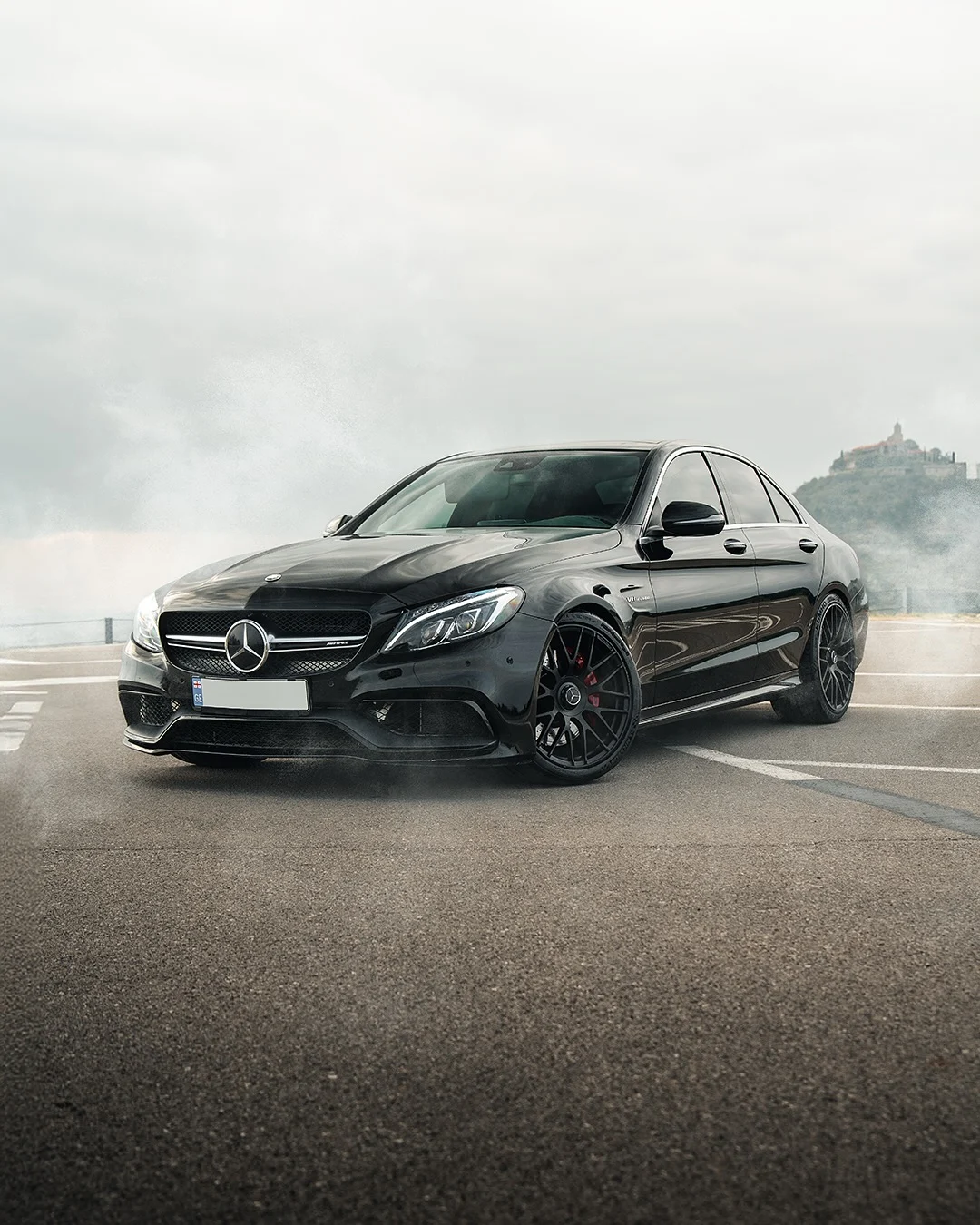
The cars in our fleet run from $150 a day for a C63 AMG to $450 a day for a 2025 G63 AMG, and a replacement panel on either of them is not a rounding error. A hold does two things at that price level. It confirms the guest is who the booking says they are, and it keeps the day rate honest instead of loading everybody's rate with a 65% risk premium to cover a small number of incidents.
The specific hold on a specific car, and the release window that goes with it, is something our concierge confirms before delivery rather than something we generalise about here. Ask for it in writing along with the answers to the three questions above. Hand delivery in Tbilisi takes about 30 minutes, and Batumi is scheduled ahead.
The honest caveat
Zero deposit with zero franchise is a legitimate model, and some Georgian operators run it properly. Georgia On Wheels states "no pre-payment, no deposit and free cancellation" alongside "no franchise and zero deductions in any accident, theft, or any other damage" on its own site. If a contract says that in writing and names its exclusions, the customer is genuinely covered and the operator has simply chosen to price risk into the rate for everyone.
The problem in this market is the silence around the model. A landing page that shouts "no deposit" and never mentions the excess is selling the half of the transaction that sounds free. Independent market observers reach for the same caution: the 2026 driving guide from Wander-Lush, which puts standard rentals around $40 to $45 a day and closer to $30 off season, tells readers to clarify excess amounts, exclusions and reporting requirements before signing.
If your route is city driving and short day trips, the whole question may not apply to you. Our rent or hire a driver comparison covers when a chauffeur removes the deposit conversation entirely.
Frequently asked
How much is the deposit for a rental car in Georgia? Local companies typically hold $100 to $300, per Helper's market summary, and some hold nothing. International desks are higher: National's Tbilisi page lists $500 for economy through standard categories and $600 for SUVs and premium. Georgian-lari operators quote in the same range, from 100 GEL at Car Rent Georgia to 500 GEL at Geo Rent Car.
Can I rent a car in Georgia without a credit card? Usually yes, with a local company. Debit cards and cash are widely accepted, and many local operators take no deposit at all. International desks are stricter, and Wander-Lush notes a credit card in the main driver's name is sometimes required for deposits and insurance holds.
What is the excess, or franchise, on a Georgian rental? The amount of any damage bill you pay before the CASCO policy pays the rest. WeRent puts the typical figure at €800 to €2,000 across many Georgian desks. Ask for the number for your specific car and check that it appears in the contract.
Does a no-deposit rental mean I cannot lose money? No. It means no money is held upfront. GoDrive's zero deposit, zero franchise option costs 65% more on the rental price and still excludes fines, fuel differences, late returns and lost keys or documents. Read the exclusions, whatever the deposit says.
How long until the deposit hold is released? Cash deposits are usually returned at handback. Card holds are released by the operator after the return inspection and then cleared by your bank, and the bank stage is the slow one. Ask for the release trigger and the number of days in writing before you sign.
What if they blame me for a scratch I did not make? Timestamped photos and a walkaround video from pickup end most of these disputes in minutes. Make sure any pre-existing damage is written on the handover sheet rather than only mentioned out loud, and photograph the signed sheet.
Does the insurance cover glass, tyres and the underbody? Often not. Helper states that policies with a deductible do not cover wheels, mirrors, glass and body damage, and WeRent lists windshield, mirrors, tyres and wheels and the underbody among the usual exclusions. On Georgian gravel these are the parts most likely to need work.
Can I take a rental into the mountains? Paved routes are normally fine, but many contracts forbid specific regions. One traveller was told his car could not go into Tusheti for insurance reasons. Off-limits territory voids cover, and at that point the excess stops protecting you and the full value of the car is at stake.
Do I need an International Driving Permit? Georgian residents in r/tbilisi report driving on foreign licences for years without one, and a licence in Latin script is generally accepted. Rental companies set their own rules, so confirm with the operator rather than with the law.
If it goes past paperwork and into a crash, the accident guide covers the first thirty minutes and who ends up paying.
Read the excess before you read the deposit, photograph the car before you take the keys, and the rest of this is paperwork. Send us your dates and the car you want and our concierge will answer with the rate, the cover and the exact hold on that car, on WhatsApp or Telegram at +995 557 437 034 or concierge@autohub.ge, usually within 15 minutes.