 Alexander wan2ted Evsin
In April 2026, Wissol opened a charging site for 12 cars near the village of Argveti on the Tbilisi–Batumi highway. Its total capacity is 720 kW, the largest site of its kind in Georgia. Chargers are also being installed at other filling stations: Wissol and SOCAR stations host chargers of the E-Space network, and Gulf stations host chargers of the EV Power network.
What has changed in recent years, and is it now cheaper to drive on electricity than on petrol? This article covers how many electric cars there are in Georgia, where they come from and what customs clearance costs, how much 100 km costs on charging and on petrol, where to charge in cities and in the mountains, and how Georgia generates its electricity.
Number of electric cars in Georgia
Vehicle registration is kept by the Ministry of Internal Affairs of Georgia. At the start of 2017, 852 electric cars were registered; at the end of 2024, 9,045. By the end of September 2026, the number had reached 25,255. That is slightly more than 1% of the 2,010,195 vehicles registered in the country. Hybrids outnumber them more than eight times: there are 213,854.
The share of electric cars grows fastest among vehicles registered for the first time. From July to September 2026 there were 40,053 such vehicles, and one in nine was electric: 4,556 cars, or 11.4%. A year earlier the share was 4.8%. In the same three months, 11,464 hybrids were registered (28.6%) and 23,925 petrol and diesel cars, 23% fewer than a year earlier.
Where the cars come from
According to Geostat, 7,926 electric cars were imported into Georgia in 2025. In the first nine months of 2026 the figure was already 10,938, more than in the whole previous year. Almost all of them come from five countries.
| Country | 2025 | January–September 2026 | Average customs value in 2025 |
|---|---|---|---|
| USA | 5,595 | 8,845 | $14,500 |
| China | 1,184 | 1,079 | $22,300 |
| Japan | 683 | 690 | $6,300 |
| Germany | 192 | 75 | $82,800 |
| Canada | 93 | 130 | $14,000 |
| Other countries | 179 | 119 | — |
| Total | 7,926 | 10,938 | $17,200 |
Note. The average value is calculated from Geostat data: the total import value from a country divided by the number of cars. This is the customs value, not the dealership price.
Note. The table includes all imported cars, but some of them do not stay in Georgia. In 2025, 1,463 electric cars were re-exported: 453 to Kazakhstan, 373 to Kyrgyzstan, 256 to Armenia and 174 to Ukraine.
Four out of five electric cars come from the US, and their customs value is about one and a half times lower than that of Chinese cars. Cars from the US are often brought to Georgia after accidents and repaired here, because repairs in Georgia cost less. David Gulashvili, deputy CEO of Caucasus Auto Import, explained this to the BBC in 2024:
In the US rebuilding of a car, and making it legal again, takes six months and let's say $5,000. It takes $1,000 and one month in Georgia to fix the same car.
BBC News
In 2025, 1,184 electric cars were imported from China, and in September 2026 the first official BYD dealership opened in Tbilisi. But the leader by number of cars is the American brand Tesla: 2,593 of the 4,556 electric cars registered for the first time from July to September 2026, more than half.
| Brand | First registrations, July–September 2026 |
|---|---|
| Tesla | 2,593 |
| Nissan | 433 |
| Chevrolet | 190 |
| Ford | 154 |
| Volkswagen | 145 |
| BYD | 133 |
| BMW | 131 |
| Hyundai | 105 |
Customs clearance: electric cars and combustion-engine cars
When a passenger car is imported into Georgia, excise tax and import duty are paid. VAT is not charged on imported passenger cars at all, whatever the engine.
A left-hand-drive electric car is exempt from both excise tax (Article 194 of the Tax Code) and import duty (Article 199). A right-hand-drive electric car pays a fixed excise tax of 3,000 GEL.
For cars with an internal combustion engine, excise tax is calculated by engine displacement. On 2 April 2026 the rates were changed by Law No. 1477: 1.5 GEL per cubic centimetre for a car up to six years old and 4.5 GEL for an older one. For a left-hand-drive hybrid up to six years old, the rate is reduced by 60%. How excise tax was calculated before and how it depends on the steering side is covered in the article on what cars drive on Georgian roads.
The difference is clear with a Toyota Prius with a 1.8-litre engine:
- 2022 Prius: about 1,080 GEL;
- 2018 Prius: about 8,090 GEL, although before 2 April it cost about 1,440 GEL;
- left-hand-drive electric car of any year: 0 GEL.
In 2026, imports of electric cars grew quickly: 537 were imported in January and 1,782 in July. Novosti Gruzii and Biznes Gruziya link this growth to the higher cost of customs clearance. Fuel prices also rose in the same months.
Fuel and charging prices
To compare costs, you need the price of a litre of fuel, a kilowatt-hour at home and a kilowatt-hour at a station. Below are these prices as of 9 November 2026.
Petrol and diesel
Prices on the websites of the major filling station chains differ by a few tetri. The table shows prices at regular pumps, not self-service.
| Station chain | Regular | Premium | Diesel |
|---|---|---|---|
| Gulf | 4.05 | 4.35 | 4.93 |
| Wissol | 4.08 | 4.39 | 4.98 |
| Rompetrol | 4.08 | 4.38 | 4.97 |
| SOCAR | 4.06 | 4.37 | 4.90 |
| Lukoil | 4.02 | 4.32 | 5.02 |
| Portal | 3.94 | 4.19 | 4.94 |
Prices are in GEL per litre.
Fuel became noticeably more expensive in 2026. According to Lukoil's price history, a litre of Regular cost 2.90 GEL on 31 January and 4.02 GEL from 26 October, 39% more. Over the same period diesel rose from 2.98 to 5.02 GEL, by 68%. According to Geostat, in October 2026 petrol cost 37% more than a year earlier.
Charging at home
Electricity tariffs for flats and houses are set by the regulator GNERC. The price per kilowatt-hour depends on how much a household uses in a month. The current tariffs took effect on 1 April 2026; prices include VAT.
| Monthly consumption | Tbilisi (Telmico) | Regions (EP Georgia) |
|---|---|---|
| up to 101 kWh | 20.041 tetri | 19.731 tetri |
| 101–301 kWh | 24.053 tetri | 23.707 tetri |
| over 301 kWh | 28.537 tetri | 28.227 tetri |
The household tariff went up by 5 tetri. The regulator gave these reasons: greater dependence on electricity imports, higher purchase costs and large upcoming investments in the grid. An electric car that drives 1,500 km a month uses about 270 kWh. Together with a flat's normal consumption, the bill will almost certainly go over 301 kWh.
Charging at public stations
Public chargers in Georgia belong to private companies. GeoCharge, a service that collects operator data, counts 15 such networks. Each company sets its own price, and within one network it may differ from station to station. Tariffs are usually visible only in the app, and few companies publish them on their websites:
- martEV, the largest network: 0.65 GEL per kWh on regular charging (AC) and 0.80 GEL on fast charging (DC).
- Electrify Georgia: from 0.44 GEL on regular and from 0.50 GEL on fast charging. After 40 minutes of charging, 0.10 GEL per minute is added, and if the car stays at the station after charging ends, 0.20 GEL per minute.
- E-Space: the price is per kilowatt-hour or per minute, and an extra fee may apply for idle time after charging. This network's chargers are also located at Wissol and SOCAR filling stations.
According to GeoCharge data for 8 November 2026, a kilowatt-hour costs less than 0.78 GEL at half of the fast stations and more at the other half. At regular chargers this price is 0.65 GEL. The most expensive fast charger costs 1 GEL per kWh.
Cost of 100 km
The table compares the Tesla Model Y, an electric car of the most popular brand in Georgia, with three popular Toyota models. Consumption is taken from US Environmental Protection Agency data (EPA). For the electric car it includes charging losses, that is, as measured at the meter. Petrol is calculated at the Regular price of 4.05 GEL.
| Car | Consumption per 100 km | Cost of 100 km |
|---|---|---|
| Toyota RAV4 2.5, 2025 | 7.8 l | 31.6 GEL |
| Toyota Corolla 2.0, 2025 | 6.8 l | 27.5 GEL |
| Toyota Prius, 2012–2015 | 4.9 l | 19.8 GEL |
| Toyota Prius, 2025 | 4.1 l | 16.6 GEL |
| Tesla Model Y Long Range AWD, fast charging at 1 GEL | 17.9 kWh | 17.9 GEL |
| Tesla Model Y Long Range AWD, fast charging at 0.78 GEL | 17.9 kWh | 14.0 GEL |
| Tesla Model Y Long Range AWD, regular charging at 0.65 GEL | 17.9 kWh | 11.6 GEL |
| Tesla Model Y Long Range AWD, at home at 28.5 tetri | 17.9 kWh | 5.1 GEL |
An electric car is cheapest when charged at home: even at the top tariff tier, 100 km costs about a quarter of what it costs in a 2012–2015 Prius. At fast stations the gap with a hybrid narrows. At 0.78 GEL, a trip in a Model Y is 16% cheaper than in a new Prius, and at 1 GEL it is more expensive. For every 10,000 km, a 2012–2015 Prius spends about 1,980 GEL on petrol, and a Model Y charged at home about 510 GEL.
Charging stations
According to GeoCharge data for 8 November 2026, Georgia has 680 public charging stations. Of these, 433 are fast. Two thirds of all stations are in Tbilisi, 457 of them. Batumi has 27 stations and Kutaisi 17.
On the Tbilisi–Batumi highway
There are chargers in all the large towns along the way: 18 in Gori, 26 in Terjola Municipality, which includes Argveti, 8 in Samtredia and 10 in Kobuleti. The most powerful stations are rated at 400 kW, but a car does not always get the rated power. The author of the YouTube channel Shutenko Family drove to Georgia from Russia in a Tesla in summer 2026 and described a fast charger near Delisi metro station in Tbilisi:
240 kW claimed… the car takes 70, so it comes to 73–74 kW.
Shutenko Family, YouTube
In the mountains
There are few stations in the mountains. Gudauri has 7, and only 3 of them are fast, up to 120 kW. Stepantsminda has 3 stations, one of them fast, at 60 kW. Borjomi has 6 stations and Bakuriani also 6, but all of them are regular. The GeoCharge database has no public stations in Svaneti: the nearest fast charger on the way to Mestia is in Zugdidi.
Connectors
Fast stations in Georgia mostly have two connector types: the European CCS2 (407 sockets) and the Chinese GB/T (392). Cars from the US have different connectors: NACS on Teslas and CCS1 on other brands. Georgia has 14 NACS sockets and 4 CCS1, so owners of American cars charge through an adapter.
At home
Charging at home is cheapest, but it is difficult in an apartment block: parking spaces near the building are usually not assigned, and there are no sockets there. A Reddit user in the Tbilisi community described how owners get around this:
I've also seen cables thrown over 4th floor balconies down to the parking level to run low rate chargers.
a Reddit user, r/tbilisi
For this reason, people with nowhere to charge are advised in the same community to choose a hybrid. A Reddit user answering a question about which car to buy for driving around Tbilisi wrote:
I personally prefer electric cars, but that's only a good option if you have place to charge it
a Reddit user, r/tbilisi
Irina Darchia, CEO of E-Motors Georgia, a company that sells electric cars, named the shortage of chargers as the main obstacle in December 2025:
When there are three or four chargers on one street, it becomes a huge incentive for a buyer to get an electric car, because they no longer need to drive around different streets to charge it.
BM.GE
Electricity sources
Most of Georgia's electricity comes from hydropower plants. According to the balance published by the market operator ESCO, in 2025 they produced 79% of generation, gas-fired thermal plants 20%, and wind and solar less than 1%. The country imported about 10% of the electricity it consumed.
In winter rivers carry less water, and the share of hydropower falls. In June 2025 almost all of the month's electricity, 99%, came from hydropower plants, and in January 44%. The rest in January came from thermal plants (29%) and imports (27%). This means that in summer an electric car in Georgia is charged almost entirely from hydropower, and in winter more than half of the energy comes from gas and imports.
Consumption is growing faster than generation. Maia Melikidze, executive director of the Georgian Renewable Energy Development Association (GREDA), gave import figures in March 2026:
As a result, last January Georgia paid around USD 9 million for imported electricity. This year, that number rose to USD 22.5 million.
BM.GE
The same BM.GE article lists electric cars among the reasons for growing consumption.
Repairs and warranty
A manufacturer's warranty is available to those who bought the car from an official dealer. The BYD dealership that opened in Tbilisi in September 2026 offers a warranty, software updates and original parts. Tesla, the most popular brand, has no official dealer in Georgia. In October 2026 a Reddit user asked how to open one:
There are a lot of Teslas already in the city so I think it's a great idea to have authorised dealership and service. We already have BYD Zeekr etc. centers but for tesla we don't even have navigation map.
a Reddit user, r/TeslaSupport
Cars from the US are repaired by independent workshops, with parts taken from salvage yards. A Reddit user who owns a BMW i4 gave this advice on finding EV parts:
As a fellow EV owner , I can give you information about people who have Wrecked EV cars and the people who are rebuilding them (salvage cars from copart). IF you want to search the model and components yourself go to mypart.ge and then search for Disassembled cars
a Reddit user, BMW i4 owner, r/Sakartvelo
How salvage yards work in Georgia is covered in the article on car dismantling yards.
FAQ about electric cars in Georgia
Is excise tax paid when importing an electric car into Georgia?
A left-hand-drive electric car pays no excise tax and no import duty. A right-hand-drive electric car pays a fixed excise tax of 3,000 GEL. VAT is not charged on any imported passenger car.
How much does it cost to charge an electric car in Georgia?
At home a kilowatt-hour costs 20 to 28.5 tetri, depending on monthly consumption. At public stations the typical price is 0.65 GEL on regular charging and 0.78 GEL on fast charging. 100 km in a Tesla Model Y costs 5 GEL when charged at home and 14 GEL at a fast station.
Is it cheaper to drive an electric car in Georgia?
Yes, if you charge at home: 100 km costs about a quarter of what it costs in a 2012–2015 Prius. If you charge only at fast stations, an electric car is 16–29% cheaper than a Prius hybrid, and more expensive at the most expensive stations. A left-hand-drive electric car is also exempt from excise tax on import.
Is parking free for electric cars in Tbilisi?
Yes. Under Tbilisi Sakrebulo Resolution No. 33-99, an electric car with a motor over 4 kW is exempt from parking fees. Spaces at charging stations may be used only while charging.
Can you drive an electric car from Tbilisi to Batumi?
Yes. There are chargers in Gori, Argveti, Samtredia and Kobuleti, and Batumi has 27.
Are there chargers in Gudauri and Kazbegi?
Yes. Gudauri has 7 stations, 3 of them fast. Stepantsminda has 3 stations, one of them fast. There are no public stations in Svaneti; the nearest fast charger is in Zugdidi.
Can you rent an electric car from AutoHub?
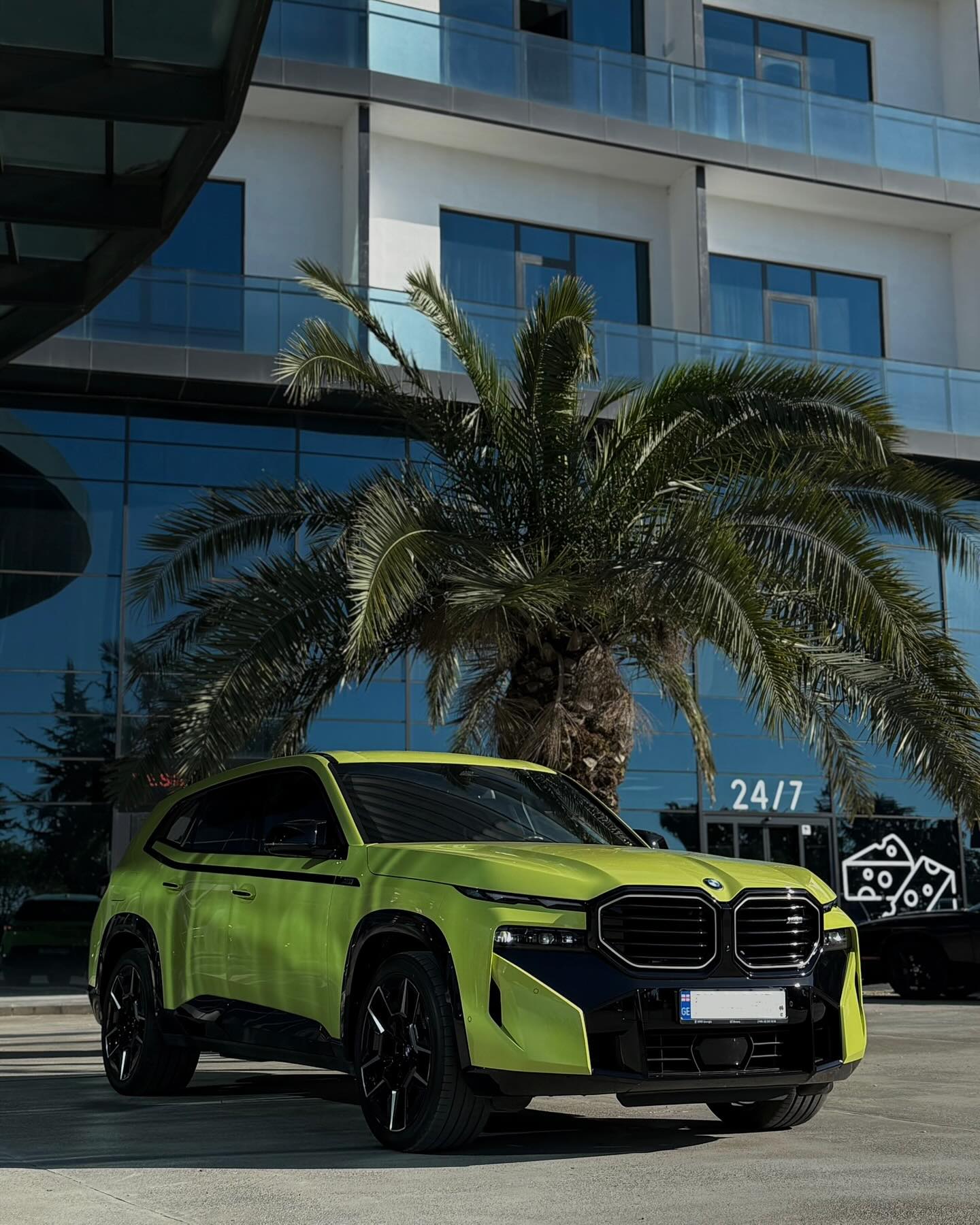
The AutoHub fleet has no fully electric cars. It has plug-in hybrids that charge from a socket: BMW XM, BMW M5, Lamborghini Urus SE and Ferrari 296 GTB.
All cars in the Tbilisi fleet are in the catalogue. In Tbilisi a car is delivered in about half an hour; terms are on the delivery page. If you prefer not to drive yourself, you can book a car with a driver.
The concierge answers on WhatsApp and Telegram at +995 557 437 034 and by email at hello@autohub.rent. Name the model and dates; documents and deposit are checked before delivery.