 Alexander wan2ted Evsin
Georgian license plates: series, prices and transit plates
The plates on the streets of Tbilisi match one another in neither colour nor layout: white with a blue band, red with white characters, white with a red band and the word TRANSIT, square and set in two rows. The designs of all these plates are approved by one government decree.
There is another feature that is not obvious at first sight: the owner of a car in Georgia picks the combination of letters and digits on the plate, and the choice decides what the plate will cost.
This article explains in detail how a Georgian plate is read, what one costs and what owners pay extra for a rare combination, how a transit plate differs from internal transit, and who receives the plates that are almost never seen on the road.
How a Georgian plate is read
Plate designs in Georgia are approved by the government, and the Service Agency of the Ministry of Internal Affairs makes and issues them. The designs in force are described in government decree No. 278 of 8 April 2014. The same decree approves the plates for trailers, motorcycles and diplomatic missions, the typeface of the characters and the design of the security hologram.
Since 1 September 2014 a car plate has been built like this: two Latin letters, three digits and two more letters. The field is white, the characters are black, and on the left there is a blue band with the Georgian flag and the letters GE. At the right edge sit a hologram and a square barcode.
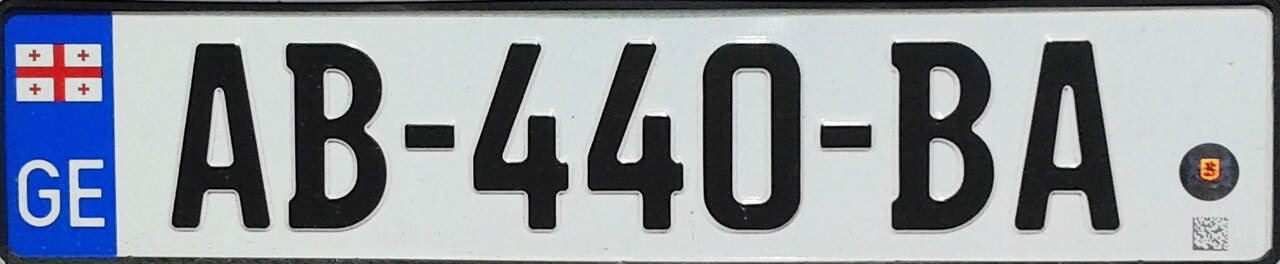
The 2014 design: two letters, three digits, two letters. Photo: Giorgi Balakhadze, Wikimedia Commons, CC BY-SA 4.0
The series tells you neither the city of registration nor the year the plate was issued. Letters in Georgia are not tied to regions, and any combination of letters and digits can be chosen for an extra fee. There is one restriction: the only combinations available are those that on the day of the application are not carried by any car and not booked by someone else.
What a plate costs
A plate cannot be bought on its own: it is issued together with putting the car on the register. According to the Service Agency price list, first registration takes three payments: 20 lari for the inspection of the car, 80 lari for the pair of plates and 100 lari for the registration certificate. Together that is 200 lari.
The same three payments apply when the owner changes: on a sale, a gift or an exchange. The price list holds no separate tariff for re-registration, so the new owner pays for the inspection, the plates and the certificate again — another 200 lari.
Eighty lari is the price of a plate issued in turn: if the owner chooses nothing, the next free combination from the current series comes up. A chosen combination is paid for separately, and the price follows the pattern of the plate: how many letters in the series repeat and how round the digits are. The law on fees lists nine groups of such combinations, and each group has its own price.
| Letters in the series | 111, 222 … 999 | 001, 002 … 009 | 100, 200 … 900 |
|---|---|---|---|
| All four the same (AA-111-AA) | 1,000 lari | 800 lari | 600 lari |
| Three of the four the same (GT-444-TT) | 800 lari | 600 lari | 400 lari |
| Two matching pairs (SO-777-SO) | 800 lari | 600 lari | 400 lari |
| Only two letters the same (RR-111-PO) | 700 lari | 500 lari | 300 lari |
| All four different (NJ-444-HZ) | 250 lari | 200 lari | 150 lari |
Every price in the table belongs to a plate whose digits form one of three combinations: three identical digits, a number from 001 to 009, or a round hundred. Other digits can be chosen too — 315 or 806, say — but they are paid for on a second scale: 250 lari when all four letters differ, rising to 450 lari when all four are the same.
The most expensive option in the price list is 10,000 lari. For that money the plate carries a combination the owner has thought up: digits, or letters together with digits, for example GIORGI 1. It may hold no more than eight characters.
The law spells out the limits on the content in detail:
კომბინაცია არ უნდა შეიცავდეს მოწოდებას, ადმინისტრაციული ორგანოს სახელწოდებას (აბრევიატურას) ან უხამსობას, აგრეთვე არ უნდა შეურაცხყოფდეს და არ უნდა ეწინააღმდეგებოდეს ეროვნულ ღირსებას, რელიგიას, ტრადიციასა და ზნეობრივ ნორმებს.
The combination must not contain an appeal, the name or abbreviation of an administrative body, or obscenity; nor must it insult or contradict national dignity, religion, tradition and moral norms.
Law on the fees and terms for services of the Service Agency of the Ministry of Internal Affairs, article 6, note 1
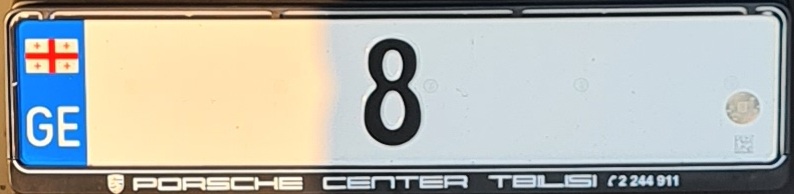
A plate made of a single digit: combinations like this cost 10,000 lari in the price list. Photo: FelixH, Wikimedia Commons, CC0
Booking, storing and handing over a plate
A combination can be held before it is issued for a car. A booking can be placed on any paid combination that is out of circulation; it costs 1.5 lari for every day and runs no longer than two calendar months. The booking can be made in your own name or in someone else's, and the plate is later issued for a car belonging to the person named in the application or, with their consent, to a car of their spouse, child or parent. It cannot be passed to anyone else, and the details on a booked plate cannot be changed.
If the owner has not collected the plate by the end of the term or has cancelled the booking, the same combination cannot be booked or issued again for at least three calendar days.
Storage works differently and covers standard plates. When a car is taken off the register the plate comes free, and the owner can keep it on the same terms: 1.5 lari a day for no longer than two calendar months.
A paid plate may be moved to a car belonging to a spouse, parent or child for 35 lari. After that the previous owner loses every right to it.
When a car is taken off the register, the plate goes back to the agency, and standard and paid plates are then treated differently: a standard one is destroyed no earlier than one working day later, while a paid one is remade at the owner's request and issued for another car of theirs or of an heir. There are 365 days for that.
The old-style plates
Before September 2014 a Georgian plate looked different: three Latin letters and three digits, for example HNH-111. The field is white here too, with the flag and the letters GE on the left, but there is no blue band, and a round hologram sits between the letters and the digits.
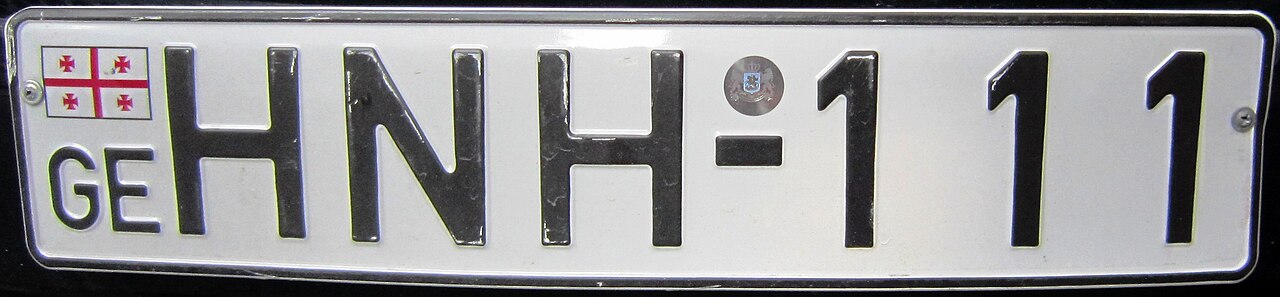
The old design: three letters and three digits. Photo: Dickelbers, Wikimedia Commons, CC BY-SA 3.0
Since 1 September 2014 the Service Agency has made and issued only the current designs. Plates issued earlier stayed valid through 31 March 2021. That deadline was set by the same decree No. 278 and passed long ago: old-style plates now carry no legal force.
A plate can be changed without a trip to the agency. Replacing an old-style plate through the agency's mobile app opened on 24 February 2021, and from 1 April of the same year current-design plates are changed the same way; the car does not have to be presented for inspection. The finished plate and certificate are collected no earlier than the fourth and no later than the sixth working day. If the owner does not come, the plates that have been made lose their force and the fee is not refunded.
Transit plates and internal transit
Not every car on a Georgian road is registered in Georgia. A car brought in to be put on the register is registered within 60 days, and until then it has no permanent plate. Temporary plates exist for cases like this. There are two kinds of them. They differ in term, in price and in the reason they are issued.
Internal transit exists so that an unregistered car can drive on Georgian roads. It is assigned when the car crosses the state border and works only inside the country, for no more than 90 calendar days. The Service Agency is approached for such a plate in one case only: when the one issued at the border has been lost or damaged. A replacement costs 50 lari.
A transit plate is issued the other way round, when a car leaves the country. Per the agency price list it costs 150 lari if the car is taken out of the customs territory of Georgia for export or re-export, and 370 lari if a car deregistered in another country passes through Georgia to a third one. The document confirming the issue of a transit plate is another 20 lari, and the loss of any temporary plate costs 30 lari.
When a car is taken off the register in order to be driven abroad, the ordinary plates are handed to the registration service and transit plates are issued for 90 calendar days in exchange.
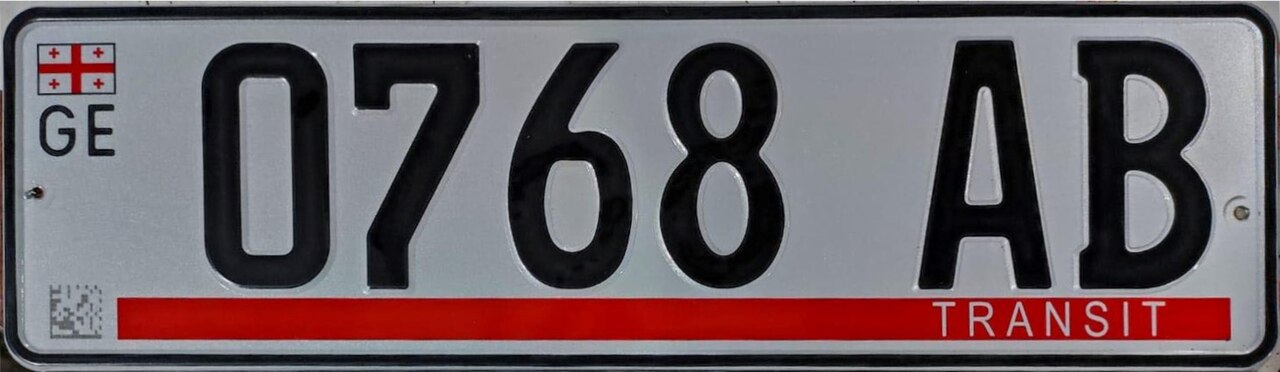
A transit plate: digits, letters and a red band with the word TRANSIT. Photo: John O. Perez, Wikimedia Commons, CC BY 4.0
On 26 December 2025 the government split the designs: until then internal transit and the transit plate were described in one annex to the decree, and now internal transit has one annex and the transit plate another.
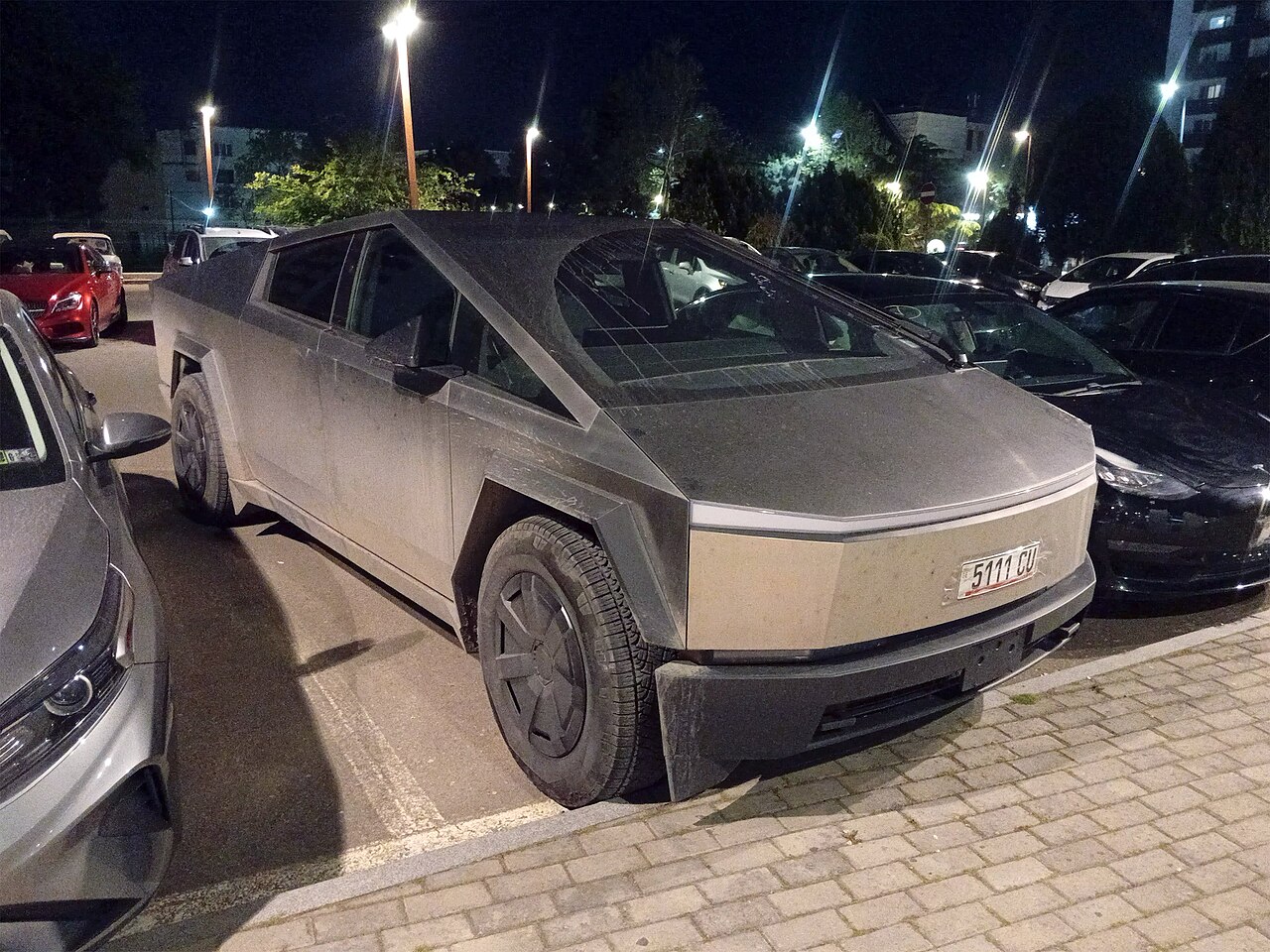
Temporary plates on a Tesla Cybertruck, Rustavi, April 2026. Photo: Yuri Samoylov, Wikimedia Commons, CC BY-SA 4.0
Who gets the remaining plates
Decree No. 278 approves more than twenty plate designs. Almost all of them are rare on the road, but none of them is easy to confuse with an ordinary plate: each group has its own field colour and its own layout.
There are several diplomatic designs: separate ones for heads of mission and ambassadors, for members of diplomatic staff, for consular officers and honorary consuls, and for the administrative, technical and service staff of missions. They cost the same as ordinary plates — 80 lari.
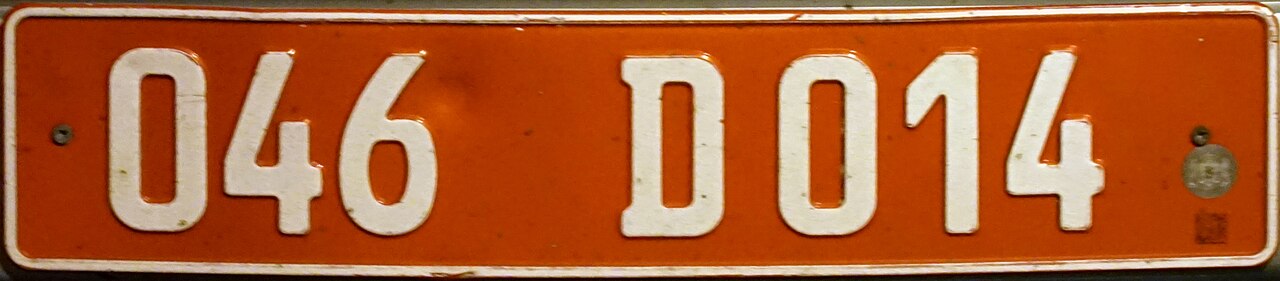
A diplomatic plate: white characters on a red field. Photo: Upwinxp, Wikimedia Commons, CC BY-SA 4.0
Motorcycles, mopeds, quad bikes and tricycles carry a square plate in two rows, and it is issued singly rather than as a pair. A chosen combination for a motorcycle costs 300 lari in every variant: both when the digits are round and when the owner picks the letters.
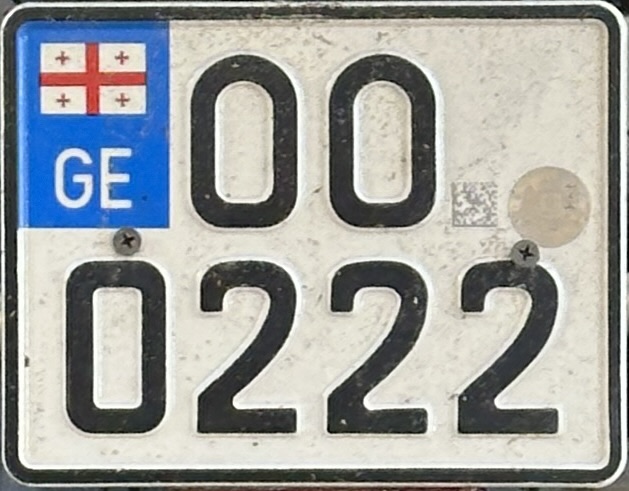
A motorcycle plate: two rows instead of one. Photo: Garosio33, Wikimedia Commons, CC0
Trailers, agricultural machinery and specialised self-propelled machines have designs of their own.
One case is singled out in the law on fees: cars of the European Union Monitoring Mission receive plates and registration certificates free of charge. That is the only exemption from payment in the whole price list. The mission has worked in Georgia since October 2008: more than two hundred unarmed civilian monitors from EU member states patrol the areas along the administrative boundary lines of Abkhazia and South Ossetia, and they drive their own cars.
The TEST plate is meant for home-built cars. Under the Ministry of Internal Affairs instruction it is issued to a newly built home-made vehicle together with a temporary certificate, before the vehicle is registered for the first time and receives a permanent plate. A pair costs 30 lari.
One more group of plates is absent from the price list. Investigative work in Georgia is carried out by law-enforcement bodies, and the cars used for it receive operational plates: the same agency issues them, but the procedure and the fee are set by an order of the Minister of Internal Affairs rather than by the general law on fees.
Questions people ask about Georgian plates
What do the letters on a Georgian plate mean? Nothing beyond the series itself. Letters are not tied to regions, and the plate shows neither the city nor the year of registration.
How much does a good plate cost in Georgia? From 150 to 1,000 lari. The cheapest is four different letters with a round hundred, the dearest is four identical letters with three identical digits.
Can I put my own name on a plate? Yes, and it costs 10,000 lari. No more than eight characters, and the combination must not contain an appeal, the abbreviation of a state body or obscenity.
Are the old-style plates with three letters and three digits still valid? No. They were valid through 31 March 2021.
How much does a transit plate cost? 150 lari when a car is taken out for export or re-export, and 370 lari when a car passes through Georgia to a third country. Internal transit costs 50 lari.
Do I need Georgian plates if I arrive in my own car? No. Internal transit is assigned at the border for up to 90 days. Registration is needed only if the car is brought into Georgia to be put on the register, and there are 60 days for that.
Can a rental car be told apart by its plate? No, the list of designs holds no separate plate for rentals. A message about a camera-recorded fine goes to the phone number held in the agency database for that car, and for a rental that is the company's number. Parking fines and towing are covered in a separate article.
How much does it cost to register a car in Georgia? 200 lari: 20 for the inspection, 80 for the pair of plates and 100 for the registration certificate.
A car does not have to be collected from an office: with delivery it is brought anywhere in Tbilisi in about half an hour and picked up the same way. Models are listed in the fleet.
Message the concierge on WhatsApp or Telegram at +995 557 437 034 or at concierge@autohub.ge, name the model and the dates, and the documents and deposit are checked before the car is delivered.
Cover photo: Giorgi Balakhadze, Wikimedia Commons, CC BY-SA 4.0