
Paid parking exists in Tbilisi, Batumi, Kutaisi and a few other cities, but there is no single system behind them. Each city hall sets its own tariffs and a different operator collects the money, so every city has its own price list and its own way of paying. Only the fines are shared: they come from one law that covers the whole country, and on 1 May 2026 they went up.
Tbilisi is the hardest city for a visitor. The capital runs two payment systems at once, and both cover the same streets. On top of that, the city's official app often rejects foreign passports at registration.
This guide covers in detail how paid parking works in the three cities, what it costs, how to pay without Georgian documents, where the underground lots of central Tbilisi are, and what to do when the car has been towed.
Where parking is paid in Georgia
Paid parking in Georgia is introduced not by the state but by each city hall separately. So one city charges for a space at the kerb and the next one does not, and one city's rules do not apply in another.
Paid spaces are established by a decision of the city council, and such decisions exist in four cities: Tbilisi, Batumi, Kutaisi and Gori. Where there is no such decision, there is nothing to pay for street parking.
There are only two ways of paying, and they differ in what exactly the money buys.
A pass is payment for a period rather than for time parked. The driver buys a week, a month or a year and leaves the car on any municipal space in the city for as long as it lasts. The pass is tied to the plate number, so there is no paper ticket for the windscreen: payment is checked against the plate.
Hourly payment covers the actual time on one particular space. Those spaces are marked separately, each carries a code on a pole, and payment is switched on at the start of the stop and off at the end.
The mix of the two differs from city to city. Tbilisi has both a pass and hourly payment, Batumi has no hourly payment at all, and Kutaisi runs both.
| City | Hour | Day | Year |
|---|---|---|---|
| Tbilisi | 1 lari in zones with a code on the pole | — | 50 lari for spaces without a code |
| Batumi | no hourly payment | 1 lari | 40 lari |
| Kutaisi | 0.5 lari | 2 lari | 60 lari |
The current price lists are published separately: the Tbilisi one inside the decision itself, the Batumi one on the city hall portal, and the Kutaisi one on the operator's site.
Tbilisi: where you pay by the hour and where you need a pass
Tbilisi runs both ways of paying at once: some spaces are paid for by the hour, the rest are covered by a weekly or annual pass. They attach to particular spaces at the kerb rather than to districts, so two neighbouring bays on the same street can be paid for differently.
What tells them apart is the code on the sign. A space with hourly payment carries a sign with a code made of a letter and digits, A722 for example: the letter marks the zone and sets the tariff. The whole code is quoted when paying, together with the car's plate number. Ordinary spaces carry no code, and hourly payment does not exist for them at all: they are covered by the municipal pass.
Hourly payment came later than the pass, and it started on a single street. On 1 August 2019 a zone with hourly payment was marked out on Kote Abkhazi street, in 2020 zones appeared in Vake and Saburtalo, during lockdown the system was suspended and then brought back on 10 February 2021. In the summer of 2025 paid spaces reached Vazisubani, Didi Dighomi and the Tskhneti highway.
Spaces without a code are the ordinary marked bays on most streets. They are covered by the municipal pass, and its price is set by the same city council decision: a week costs 4 lari, six months 25, a year 50.
Spaces with a code are marked on the busiest streets: by Freedom Square, in Abanotubani, in Vake and Saburtalo. An hour in zone A costs 1 lari. The same decision approves more expensive zones as well: B and C. An hour in zone B costs 2 lari, in zone C 3.
Drivers who leave the car in coded zones every day have a third option: a pass for the hourly zone itself. While it lasts there is no need to switch payment on for each hour, the car is simply left on any zonal space in the city. In an explanation from Tbilisi City Hall published by the InterPressNews agency in June 2022, both a company and a private person may buy it, and the number of passes per company is not limited. It costs considerably more than the ordinary one: a day 20 lari, a week 100, a month 300, six months 500, a year 800.
| Period | Pass for ordinary spaces | Pass covering coded zones |
|---|---|---|
| 1 day | — | 20 lari |
| 1 week | 4 lari | 100 lari |
| 6 months | 25 lari | 500 lari |
| 1 year | 50 lari | 800 lari |
The difference between the two kinds of spaces was put best by a Tbilisi resident on Reddit. He was answering a tourist who stood by a sign without a code and could not tell whether the parking was paid:
You need parking pass for parkings without numbers (like A456 for example) and it’s relatively cheap (50 GEL annually). If it’s numbered parking, you won’t need a pass but you have to enable hourly parking using app or buy expensive parking pass that covers numbered parkings as well (800 GEL annually).
u/ChromedGonk, r/tbilisi
The free 15 minutes
Hourly payment in a zone does not start with the first minute. Under the city council parking decision the driver has an allowance for short stops, and those minutes are not charged.
There are four free stretches a day, 15 minutes each and each on a new space. From the fifth stop the tariff counts from the first minute. For quick errands in the centre that is usually enough: grabbing a coffee, dropping off a passenger.
Batumi: a pass instead of hours
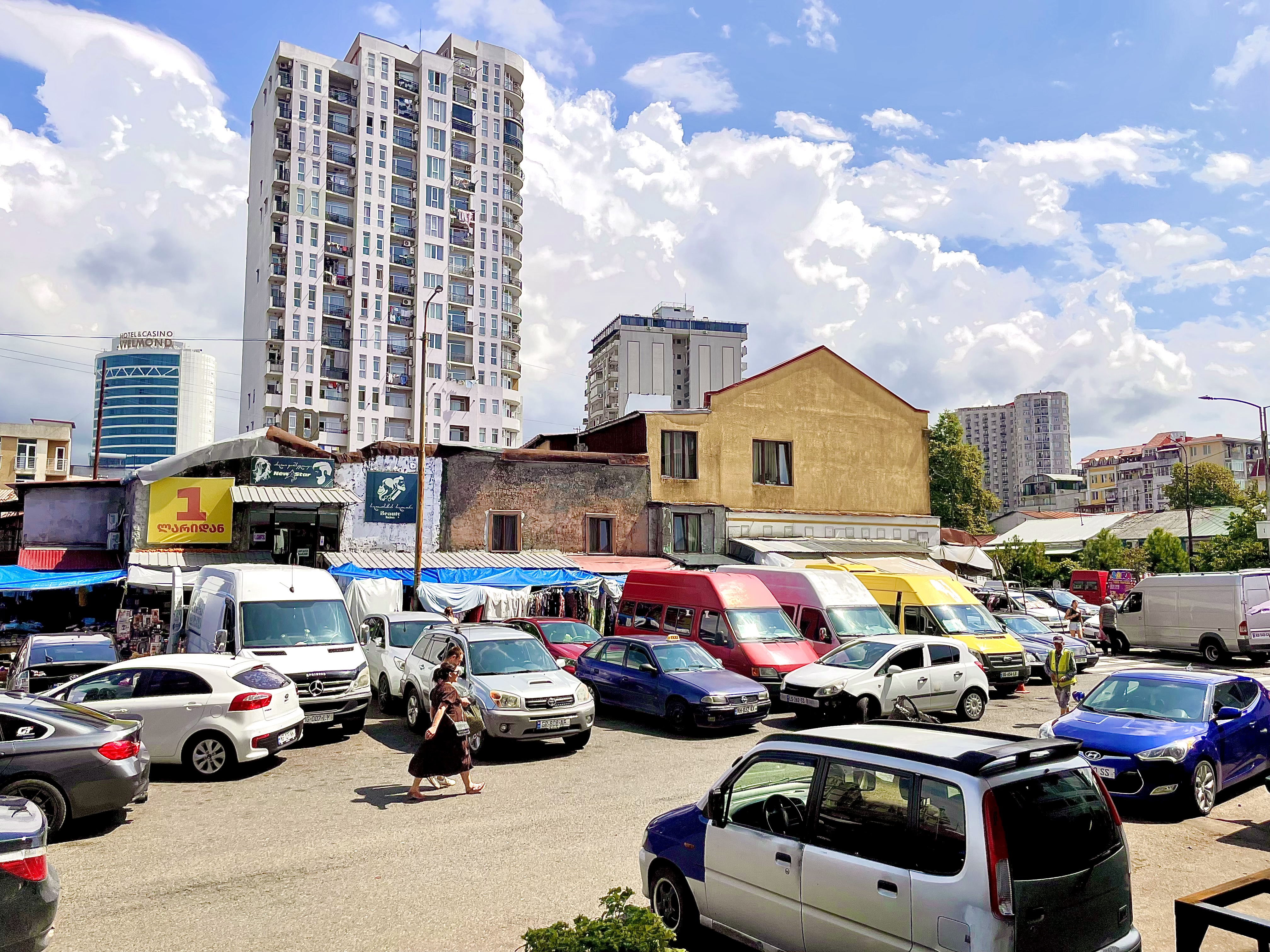
A parking area by the market on Sergei Esenin street in Batumi. Photo: AlexandreAssatiani, Wikimedia Commons
Tbilisi rules do not apply on the coast. Paid spaces in Batumi are run by the municipal service Batumi Avtotransporti, and its system is simpler than the capital's.
There is no hourly payment in the city at all: a space at the kerb cannot be paid for an hour or two. The driver buys a pass for a period and leaves the car on any paid space in the city while it lasts. The shortest period is a day.
| Period | Price |
|---|---|
| A day | 1 lari |
| A week | 5 lari |
| A month | 10 lari |
| Six months | 25 lari |
| A year | 40 lari |
These prices are published on the city hall portal. The city council decision that introduced paid parking names different amounts for two of the periods: a week 4 lari, six months 20. The month and the year match in both sources, so it is the weekly and the six-month pass whose price is worth checking when you pay.
For details the city hall points to the service's site batumitransport.ge and to its phone number, +995 422 21 21 89.
Kutaisi: both the hour and the pass
The third city with paid parking of its own is Kutaisi, and it is built closer to the Tbilisi model than to the Batumi one. The spaces are run by the company Parking Service, and payment covers either the time parked or a period.
Hourly payment comes with a discount for length: an hour costs 0.5 lari, while three hours in a row cost 1 lari instead of one and a half. Every hour after that is 0.5 again.
| Period | Price |
|---|---|
| Up to 1 hour | 0.5 lari |
| Up to 3 hours | 1 lari |
| Each further hour | 0.5 lari |
| A day | 2 lari |
| A week | 5 lari |
| A month | 10 lari |
The long passes differ between the two sources. The city council decision as amended on 28 December 2022 sets ceilings of 25 lari for six months and 40 for a year, while the operator's price list names 30 and 60. Before buying such a pass the price is worth confirming with the operator on 0431 310 310.
Taxis and heavy vehicles are charged separately. For a taxi it works out at a lari a day: 10 days cost 10 lari, 30 days 30. For lorries and special vehicles a day costs 3 lari and a year 250.
Tariffs are approved by city halls and they change. Before paying, check the price on the terminal or on the operator's site.
Paying for parking without Georgian documents
Every city has its own operator, so the payment channels differ. The difficulty for a visitor is the same everywhere: the official services are built around a Georgian personal number and do not always accept a foreign passport.
Tbilisi. The standard way is the Parking Tbilisi app from the App Store or Google Play: you add the plate number, top up the balance with a card, and switch hourly parking on and off. With foreign documents registration often fails. The app asks for a personal or document number and answers "Not Found", and a seven-digit passport number does not pass a check written for eight. Visitors complain about it constantly:
Yea, the app is trash for foreigners. I also couldn’t register due to some problem with the passport number. Try contacting your rental car service, maybe they’ll help with a georgian passport number.
u/ParkingLandscape711, r/tbilisi
There are two ways around the app, and neither needs registration:
- BOG and TBC street terminals — the orange and blue machines all over the city. They take cash and cards, and the menu has English.
- The bogpay.ge site — the payments section for foreign cards: transport → parking → Tbilisi Parking, then the plate number in Latin letters and the zone code from the pole.
Batumi. The pass is paid for at a bank, at a street terminal or online. Payments and fines are checked on the service's site, batumitransport.ge.
Kutaisi. Parking is paid for through the same banking terminals and on the operator's site, where the issued fines are published as well.
With a rental car, the first thing to ask at pickup is how parking is arranged for that particular car: at some companies the plate is already on an annual pass, at others the office pays the zone from its own account and all you have to do is pass on the code from the pole. One tourist on Reddit could not add a rental car to the app, and the answer came from other people in the thread rather than from the rental company:
Thanks so much! Reddit was more helpful than the rental company :)
u/il-liba, r/tbilisi
The answer in his case was simple: in the "personal number" field the app expected the details of the car's owner, that is, of the rental company.
Underground lots in Tbilisi: where to leave the car all day
Street zones do the job for an hour or two, but for a whole day in the centre an underground lot is more convenient. Such lots work under Freedom Square, under Orbeliani Square, at Rike by Europe Square and in the Galleria shopping centre on Rustaveli. All of them are private, the owner sets the tariff, and the price is written up at the entrance.
For a walk around the old town that is convenient. The car stays under Freedom Square, and from there you can go on foot: Abanotubani is less than two kilometres away.
A street space costs less than an underground one, but it comes with two inconveniences a lot does not have. Street parking needs watching: in a coded zone payment is switched on and off, and a pass runs to a fixed date. And a car left in breach of the rules is towed away from the street. So for a whole day and for the night an underground lot is more convenient, even at a higher hourly price.
Fines: what for and how much
Fines are built differently from tariffs. The price of parking is set by each city hall separately, while the penalty for a breach is set by the Code of Administrative Offences, article 125, and applies across the country. Only the amounts differ: for some breaches the big cities and the resorts charge more than everywhere else.
| Breach | Nationwide | In big cities and resorts |
|---|---|---|
| Parking not paid for | 50 lari | 50 lari |
| Parking under a "no parking" sign | 10 lari | 50 lari |
| Parking on a pavement or a pedestrian crossing | 10 lari | 100 lari |
| Parking in a bicycle lane | 100 lari | 100 lari |
| Parking in a space for people with disabilities | 200 lari | 200 lari |
The code names eleven big cities: Tbilisi, Kutaisi, Batumi, Mtskheta, Rustavi, Gori, Telavi, Poti, Zugdidi, Akhaltsikhe and Ozurgeti. Resorts are treated the same way. The fine for unpaid parking is outside that list: it is the same everywhere parking is paid.
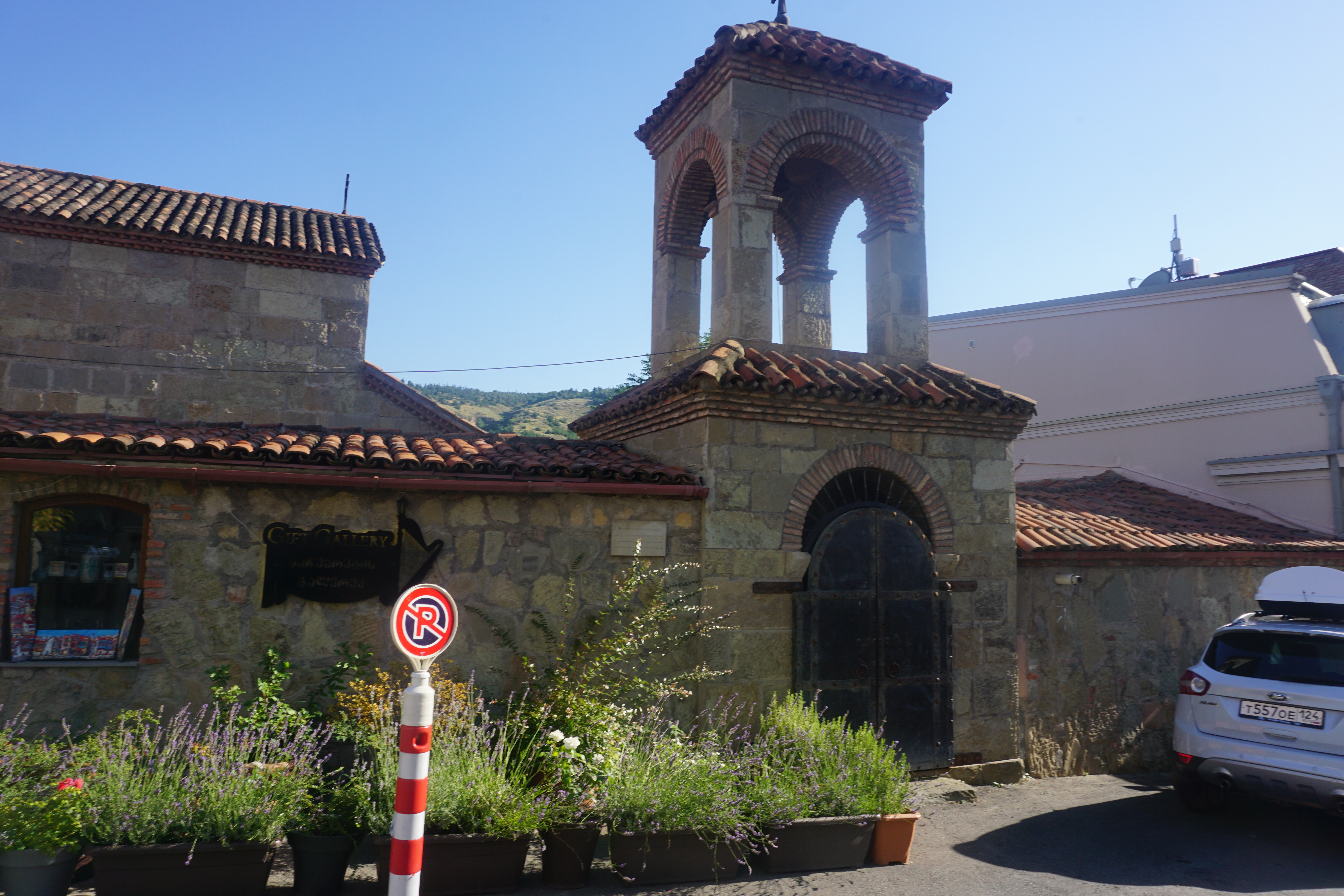
A "no parking" sign in old Tbilisi. Photo: Andrew Milligan sumo, Wikimedia Commons
The breach is recorded by photographing the plate and the decision is issued electronically, so a car is fined with no driver present. The fine is paid at the same BOG and TBC terminals or online.
With a rental car the decision goes to the rental company as the owner of the plate, and the company rebills the renter. The mechanics are the same as with the deposit and the excess.
Towing: where the car went and what it costs to get it back
Not every breach ends with a fine. Unpaid parking earns a decision but the car stays where it is, while a car on a pavement, a crossing or a bicycle lane is taken to the impound lot.
Getting the car back is paid for separately from the fine, and the bill has two parts. Towing costs 150 lari and storage 20 lari a day. The Tbilisi city government raised those amounts in March 2022 two and a half times over. Before that towing cost 60 lari and a day of storage 10.
The fine comes on top of that. If the car was taken from a pavement, the first day costs the driver 270 lari: 100 lari of fine, 150 for the towing and 20 for the storage.
Visitors often write that nobody checks parking payments in Tbilisi anyway. Locals answer briefly:
they also get fined for parking without paying and their car lifted onto a truck and taken away.
u/Ok-Dress-341, r/tbilisi
If the car is not where you left it, the order is this:
- Find the car on parking.tbilisi.gov.ge or in the Parking Tbilisi app: they show which impound lot it was taken to.
- Call the rental company straight away. The impound lot asks for the car's documents, and the car is registered to the company.
- Pay the towing and the storage, and collect the car the same day, before the storage bill grows.
Questions people ask about parking in Georgia
Which Georgian cities have paid parking? Decisions on paid spaces have been adopted in Tbilisi, Batumi, Kutaisi and Gori. Where there is no such decision, street parking is not charged for.
How much is an hour of parking in Tbilisi? 1 lari in zone A, which covers almost all of the paid centre. The first 15 minutes are free, four times a day on different spaces.
Is parking paid at night and at weekends? Yes. The zonal system has no free hours and no days off.
How do I pay without a Georgian personal number? At BOG and TBC street terminals or on bogpay.ge: all you need is the plate number in Latin letters and the zone code from the pole. The Parking Tbilisi app does not always accept foreign documents.
Do I need a pass if I only park in coded zones? No, those spaces are paid for by the hour. The 50 lari annual pass is for spaces without a code. There is also a pass for the zones themselves, at 800 lari a year.
What is the fine for unpaid parking? 50 lari. Parking on a pavement or a crossing costs 100 lari in the big cities and resorts, a bicycle lane 100 lari anywhere in the country, and a space for people with disabilities 200. With a rental car the fine goes to the rental company and is rebilled to you.
What do I do if the car has been towed? Find the impound lot on parking.tbilisi.gov.ge, call the rental company and pay for the return: 150 lari for the towing plus 20 lari for each day of storage.
How much is parking in Batumi? There is no hourly payment there. A day costs 1 lari, a week 5, a month 10 and a year 40. Payments and fines are checked on batumitransport.ge.
How much is parking in Kutaisi? An hour costs 0.5 lari, three hours in a row 1 lari, a day 2 and a month 10. The spaces are run by the company Parking Service.
Are there underground lots in central Tbilisi? Yes: under Freedom Square, under Orbeliani Square, at Rike and in the Galleria shopping centre. They are private, the price is written up at the entrance, and for a whole day they beat the street zones.
The parking question is easiest to settle before the trip: the AutoHub fleet holds 74 cars from 85 dollars a day, and with delivery the car is brought to you and collected anywhere in Tbilisi, so there is no hunting for a space by a rental office.
The concierge takes care of the rest: write on WhatsApp or Telegram at +995 557 437 034 or to concierge@autohub.ge, name the model and the dates, and the documents and the deposit will be checked before delivery, along with how parking is arranged for the car you chose.
Cover photo: Andrew Milligan sumo, Wikimedia Commons