 Alexander wan2ted Evsin
The village of Omalo in Tusheti is 150 kilometres from Tbilisi. The road there runs over the Abano Pass at 2,850 metres, takes six to eight hours and works only in summer: from autumn to May the pass is closed by snow. A helicopter reaches Omalo in under an hour, and the season makes no difference to it.
You would think that, with a gap like that, everyone would fly. Yet helicopters are booked rarely in Georgia, and the reasons are simple. This article covers where a helicopter actually flies in Georgia, what an aircraft costs, where it can land and what stops a flight from happening.
Commercial flights: who operates them, what is sold, what they fly
Every commercial flight in Georgia starts from the base in Tbilisi: that is where the aircraft departs from and returns to. From there you can reach Kazbegi, Tusheti, Svaneti, Khevsureti and Batumi.
Under the Air Code of Georgia, carrying passengers for money requires two documents — an operator's certificate and an air transportation certificate. Both are issued by the Civil Aviation Agency, and flying without the certificate is prohibited. Thirteen companies in Georgia hold an operator's certificate, but nearly all of them fly aeroplanes and need it for their own services. Only four have helicopters: TCA, Aero Expedition, Aviacopter and Aviaservice. The first two carry passengers; the others do air ambulance work. In total the Georgian civil register holds twelve helicopters.
Companies that sell helicopter tours and transfers but do not appear in the operators' register work as intermediaries: they take the booking and hire the aircraft from a certified operator. That is a normal arrangement. One thing matters: the flight is the responsibility of the certified airline, not of whoever took your money.
Four kinds of flight can be booked. The first is a mountain transfer: Omalo, Stepantsminda, Mestia, Shatili. The second is a sightseeing loop over Tbilisi and Mtskheta, the shortest and cheapest option. The third is a custom route, charged by flying hours. The fourth is heli-skiing: skiers are lifted to a slope with no lift and ski down untouched snow. Those flights need a separate permit from the Civil Aviation Agency. They are allowed by day only and only in good weather, when the ground and landmarks are visible from the cockpit. The captain must have at least a thousand hours flown as pilot in command and clearance to choose a landing site from the air.
Two models are used commercially. The first is the Airbus H125, also known as the AS350 B3: one engine, five passengers, a cruising speed of about 250 kilometres per hour. It was on this type that a landing was made on the summit of Everest in May 2005, still the highest point a helicopter has ever landed on. The second is the Agusta A109: two engines, six passengers and a crew of two. It costs more, but the second engine lifts some of the restrictions. If a single engine fails, the helicopter has to land immediately, which is why single-engine aircraft are barred from night flights. The A109 keeps flying on the remaining engine, so it may fly after sunset.
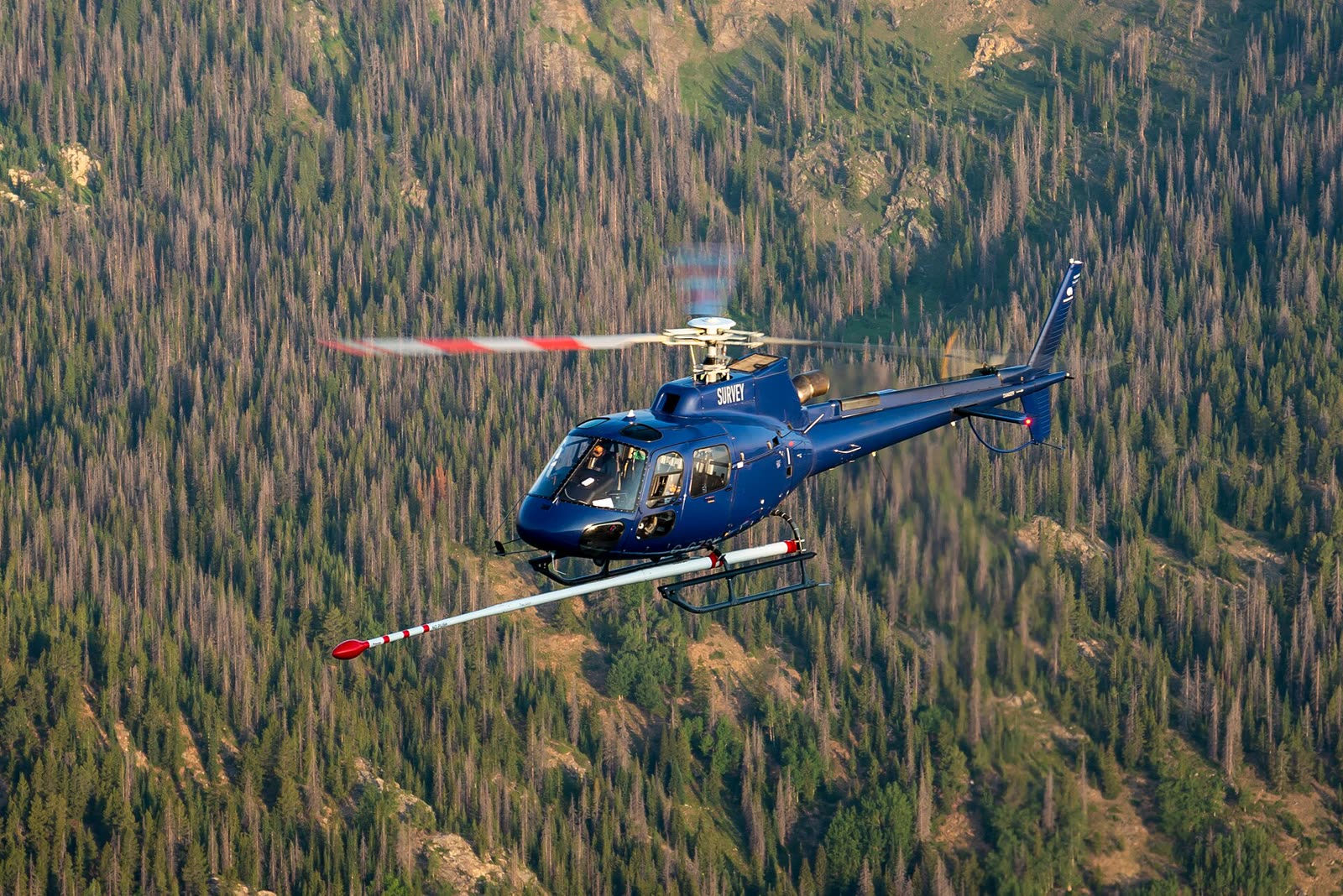
Airbus H125 — the most common model in Georgia; the aircraft in the photo belongs to the US Geological Survey. Photo: USGS, public domain
Where you can fly and how long it takes
TCA and Aero Expedition, the two companies licensed to carry passengers, fly from Tbilisi to seven places. Telavi is the closest — 30 minutes by air; Batumi the farthest at an hour and a quarter.
| Destination | By air, one way | By road, one way |
|---|---|---|
| Telavi | 30 minutes | 1 hour 50 minutes |
| Kazbegi (Stepantsminda) | 40 minutes | about 3 hours |
| Shatili | 45 minutes | 5 hours and more |
| Omalo, Tusheti | 50 minutes | 6–8 hours, summer only |
| Ambrolauri | 50 minutes | about 4 hours |
| Mestia | 1 hour 10 minutes | 8–9 hours |
| Batumi | 1 hour 15 minutes | 5–6 hours |
The operator publishes the whole flight time — from the Tbilisi base to the destination and back, because the aircraft's entire journey is paid for. In the table it is halved.
Simply to get somewhere faster, a helicopter is rarely booked. Telavi is a two-hour drive anyway. Batumi and Ambrolauri are served by scheduled flights from Natakhtari at 125 and 50 lari. A helicopter makes sense where there is no road or the road is closed. Tusheti has no asphalt at all, and the Abano Pass opens in May and closes in October. In the summer of 2026 the opening failed, and the region was still cut off in June.
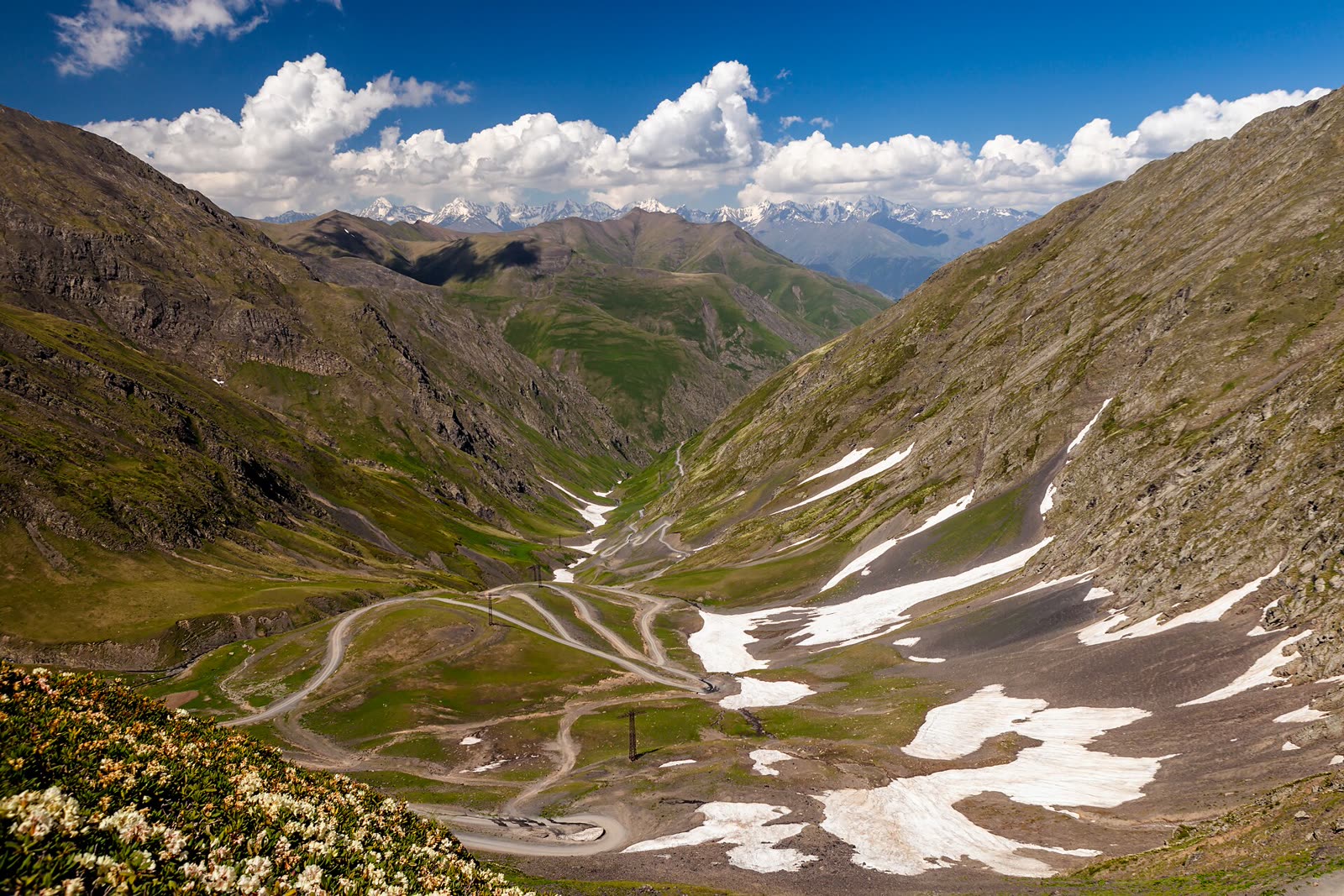
The view from the Abano Pass. Photo: Moahim, CC BY-SA 4.0
The cost: aircraft, pilot and flying hours
A helicopter in Georgia comes with its crew, and the pilot is part of the price. You cannot take the controls yourself. That needs a pilot's licence and a type rating, and there are no "rent the aircraft and fly it yourself" offers here. The licence itself is obtainable: private pilots are trained at flight schools in Tbilisi.
You pay for the whole aircraft rather than a seat, and the price is published by the operator, not the intermediary. Here is the current Aero Expedition price list — one of the two companies that carry passengers:
| Route from Tbilisi | Price per aircraft |
|---|---|
| Omalo, Tusheti | 3,500 USD |
| Stepantsminda (Kazbegi) | 3,500 USD |
| Mestia | 7,500 USD |
| Batumi | 7,500 USD |
| Sightseeing loop over Tbilisi and Mtskheta | 1,480 USD |
| Custom route | from 2,200 USD per flying hour |
Airport fees are added on top. The whole time from the Tbilisi base and back is charged, and on site the helicopter and pilot wait up to two hours free of charge — after that the hourly rate applies.
An hour of flying costs roughly the same everywhere in Georgia: about 1,800 dollars on a single-engine helicopter and about 2,300 on a twin. Our own fleet has two Airbus H125s, taken from 2,000 dollars per flying hour — pilot and insurance included, with the concierge putting the route together.
For comparison: the scheduled aeroplane from Natakhtari costs 50 lari per person to Ambrolauri and 125 to Batumi. The difference is not only in the sum. On a scheduled flight you buy one seat and travel to a timetable. A helicopter is paid for in full, but the route and the time are the customer's to choose.
Where a helicopter can land
Reaching Kazbegi is only half the job: there is no aerodrome there, nor in Omalo, the most frequent destination. Georgia has just six certified civil aerodromes — Tbilisi, Batumi, Kutaisi, Mestia, Ambrolauri and Natakhtari — while the aerodrome in Telavi is not certified and is closed by notice to airmen until 4 November 2026. So in most of the places listed above there is formally nowhere to land.
That does not mean you cannot get there. The flight rules permit take-off and landing away from certified aerodromes and heliports on three conditions: the landowner consents to such use, the site is protected around its perimeter from people and moving objects and is safe for take-off and landing. No separate permission from the Civil Aviation Agency is needed for a one-off landing.
A site has to be registered in other cases: if scheduled flights on fixed routes are operated from it, if aircraft are based and maintained there, or if flights are planned for longer than a month. Registration takes up to 120 calendar days, requires coordinates from a surveyor and the written consent of the municipality, and is valid for five years.
Landing on a pad by a hotel in Kazbegi or on a field by a Kakheti vineyard is a matter of agreement with the landowner and the captain's assessment of the site, not of months of correspondence with an agency.
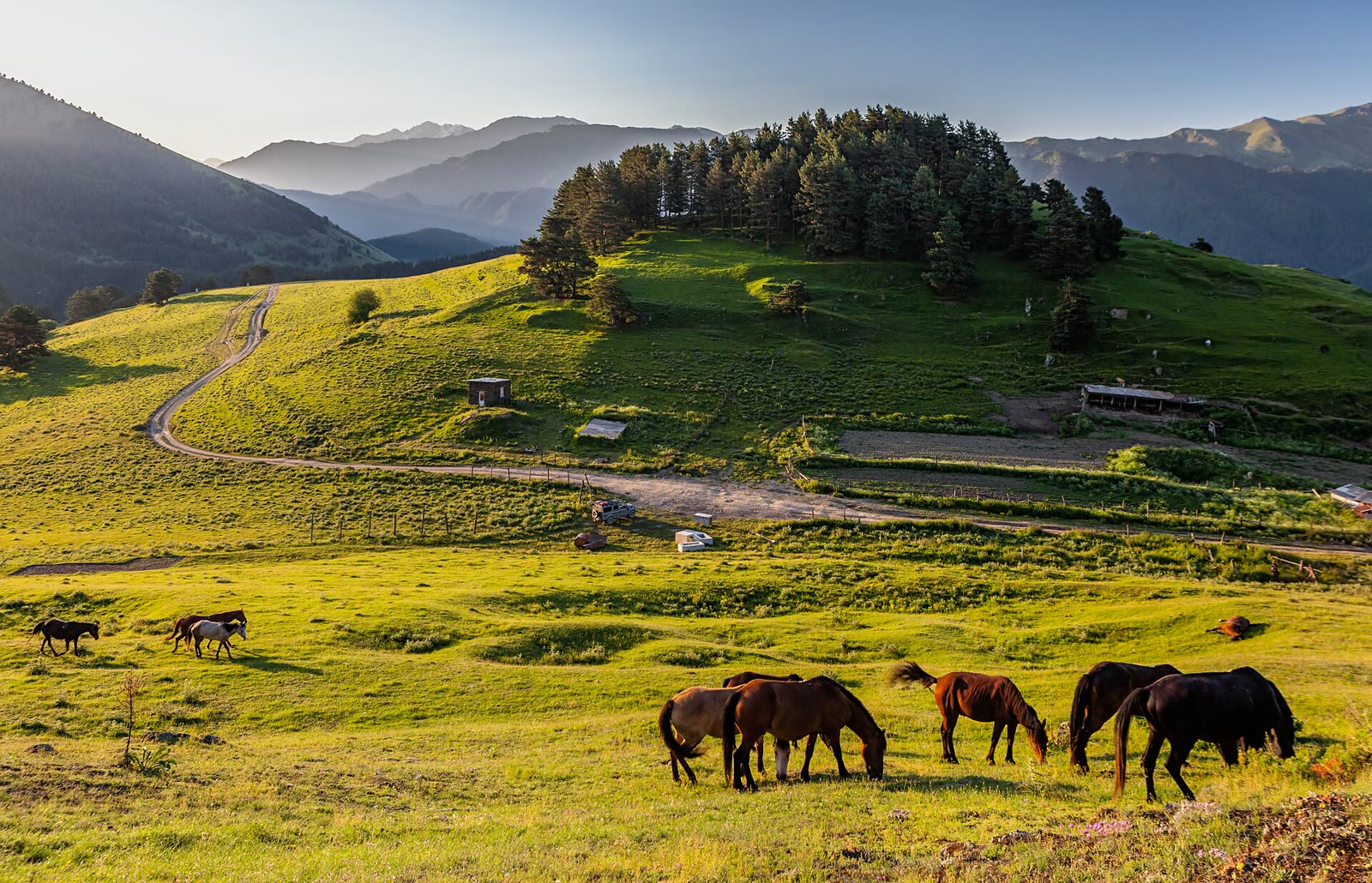
Upper Omalo in Tusheti — there is no aerodrome here. Photo: Moahim, CC BY-SA 4.0
What to allow for when planning a flight
A helicopter is not hailed like a car: the flight is planned in advance, and some are cancelled before departure. There are five constraints, and almost none of them is up to the operator.
The first is daylight. The pilot flies by reference to the ground and the horizon rather than by instruments alone, so he needs to see what is below. If the engine of a single-engine helicopter fails, it has to land immediately and wherever it can — and at night a suitable spot cannot be made out. That is why such helicopters, the H125 and the Alouette III among them, are barred from flying between sunset and sunrise, and the last flight ends at dusk.
The second is weather. Flights are allowed with visibility of three to five kilometres, the exact figure depending on altitude and area. Cloud base for take-off and landing in the aerodrome zone must be no lower than 450 metres above the ground. In the mountains a further requirement applies: the route is planned at least 600 metres above the highest obstacle within eight kilometres. Low cloud in the mountains cancels the flight, and that is not the operator being cautious but the rule.
The third is the flight plan. It is filed no later than 30 minutes before departure: in controlled airspace this is mandatory. There is one exception: if the whole flight stays in uncontrolled airspace no higher than 400 feet — about 120 metres above the ground — no plan is needed. In that case the route, the type of helicopter and the captain's contact details can be passed to air traffic services by any means, down to a phone call (rules of flight in the airspace of Georgia).
The fourth constraint is seasonal and concerns Kakheti. The vineyards here are protected from hail with rockets: a reagent is fired into the cloud so that the hail does not have time to grow. The firing is from the ground and to a considerable altitude, so separate zones are marked over the launch areas and flights in them are restricted.
There are nine such zones, all labelled Kakheti Zone in Georgia's aeronautical information publication: from the ground to flight level 310, roughly nine kilometres, from April to the end of October. The zones also cover the strip along the Russian and Azerbaijani border that takes in Tusheti. There is no permanent ban — flights are restricted during the hours when firing takes place, and warning is given in advance.
The fifth is the patches of sky that are off limits. One place in the country is closed to flights altogether: a circle two nautical miles in radius over the oil terminal at Supsa. More than forty further zones are closed as circumstances require. Most of them are Ministry of Defence firing areas running along the Armenian and Azerbaijani borders. Abkhazia and the Tskhinvali region are closed for a different reason: under the law on occupied territories the airspace above them counts as occupied too, and international air traffic there is prohibited.
The law does not require the border police to be notified of a domestic flight near the border. Clearance from the Ministry of Defence and notification of the Interior Ministry are needed only for crossing the state border outside an air corridor.
Frequently asked
Can a helicopter land right at my hotel in Kazbegi? Yes, if the landowner agrees, the site is protected around its perimeter and the captain judges it safe. No separate permission from the aviation authorities is needed for a one-off landing.
Do I need a permit for the border regions? No. An identity document is enough to enter the border zone.
Can I fly in the evening or at night? Not on a single-engine helicopter: flights between sunset and sunrise are prohibited for those aircraft. The return has to be planned for daylight.
What happens if the weather turns? The flight is postponed. The pilot flies by reference to the ground and the horizon, so low cloud in the mountains makes the flight impossible regardless of what either side wants.
How many people fit in a helicopter? The Airbus H125, the most common type here, takes five passengers plus the pilot. The Agusta A109 takes up to six passengers, but with a crew of two.
Is the flight cheaper with fewer passengers? No. The whole aircraft is paid for, not the seat, so the price is the same for one passenger and for five.
Can I reach Tusheti in winter? Technically yes, in suitable weather — and it is the only way in when the Abano Pass is closed. There are no scheduled or subsidised flights there for tourists.
How long does the helicopter wait on site? Under the operator's terms, up to two hours free of charge; after that the time is charged at the hourly rate.
A helicopter earns its keep where there is no road or the road is closed. In every other case the same trip by car costs a fraction of it.
An SUV from the fleet is delivered across Tbilisi in about half an hour. For mountain roads you can add a driver. Message the AutoHub concierge on WhatsApp or Telegram at +995 557 437 034, or write to concierge@autohub.ge.
On the cover — the road to Omalo through Tusheti. Photo: Moahim, CC BY-SA 4.0.