 Alexander wan2ted Evsin
Georgia is not among the markets where Tesla has launched Full Self-Driving. As of August 2026 the system works in eleven countries: the United States, Canada, Mexico, Australia, New Zealand, South Korea, the Netherlands, Lithuania, Estonia, Denmark and Belgium. There is a second list — countries where Tesla is waiting for regulatory approval to launch; Georgia is not on that published list either, and neither are Armenia and Azerbaijan.
Cars with driver assistance nevertheless drive Georgian roads every day, and Tbilisi workshops sell "FSD activation". This article covers which functions actually switch on in Georgia, which will never switch on, what gets in their way on local roads, and who is liable when an assistant gets it wrong.
Where Georgia's cars come from, and who they were built for
The country has no car industry of its own, so every car here was imported. A new one can be bought in Tbilisi from an official dealer — Toyota, BMW, Porsche, Volkswagen, Kia and others all have centres here — and such a car arrives through the normal supply channel, as in any country without domestic production.
The main flow is different. Cars are bought at American auctions, often after crashes, shipped to Poti and Batumi, rebuilt locally and sold — some in Georgia, some onward to Armenia, Azerbaijan and Central Asia. Repair work is cheap here, which is why the scheme has run for decades; what it looks like from the buyer's side is covered in the article on classic cars. The scale shows in the import figures: in 2025 Georgia imported 2.78 billion dollars' worth of vehicles from the United States against 346 million from Japan, according to the UN COMTRADE database.
The difference between the two channels matters for the electronics. A manufacturer builds a car for a specific market and its rules: it certifies the car in that country, unlocks a set of functions for local buyers and loads the maps of that region. A dealer car was built for the local market, an auction car for someone else's — and that binding does not disappear on resale, because it is written into the car itself.
Levels of automation: from cruise control to FSD
Systems of very different complexity are sold under the word "autopilot", and the name tells you nothing about what the car can actually do. They are distinguished by levels of automation — a scale from zero to five used by manufacturers and regulators alike. The level says which actions the car takes on and which remain the driver's duty.
The simplest is adaptive cruise control. The car holds a set speed and a distance to the vehicle ahead. If the car in front brakes, yours slows with it, and when the road clears it returns to the set speed. The steering is yours.
The second level adds lane keeping. The car reads the markings and steers to stay between the lines, so it handles both speed and position on the road. On a smooth road with clear markings it covers kilometres without input; where the markings have worn away, it hands the wheel back.
Full Self-Driving belongs to the same level, despite the name. It drives the car along a set route — changing lanes, turning at junctions, stopping at lights — but a human still watches the road, and Tesla itself calls the system Supervised.
The right not to watch the road appears only at the third level. Two European makers had such systems, and by August 2026 both were gone: Mercedes closed Drive Pilot in January, BMW closed Personal Pilot in February. No car in Georgia has a third-level system, so the driver must keep control of the road at all times, whatever is switched on.
What depends on the car, and what on the market
The first two levels do not depend on the country. Adaptive cruise control and lane keeping are either in the car or not: it is a matter of trim and model year, not of the border the car has crossed.
Trim, however, has stopped being a fixed thing. In January 2026 Tesla removed lane keeping from the base trim of new Model 3 and Model Y cars in North America: only adaptive cruise control remained as standard, and the steering assist became a paid option at 99 dollars a month. Electrek reported it. In Europe the same started with the Netherlands, while in Germany lane keeping is still part of the base trim. So the set of assistants in a given car is determined by where and when it was bought: two visually identical Model Ys can behave differently.
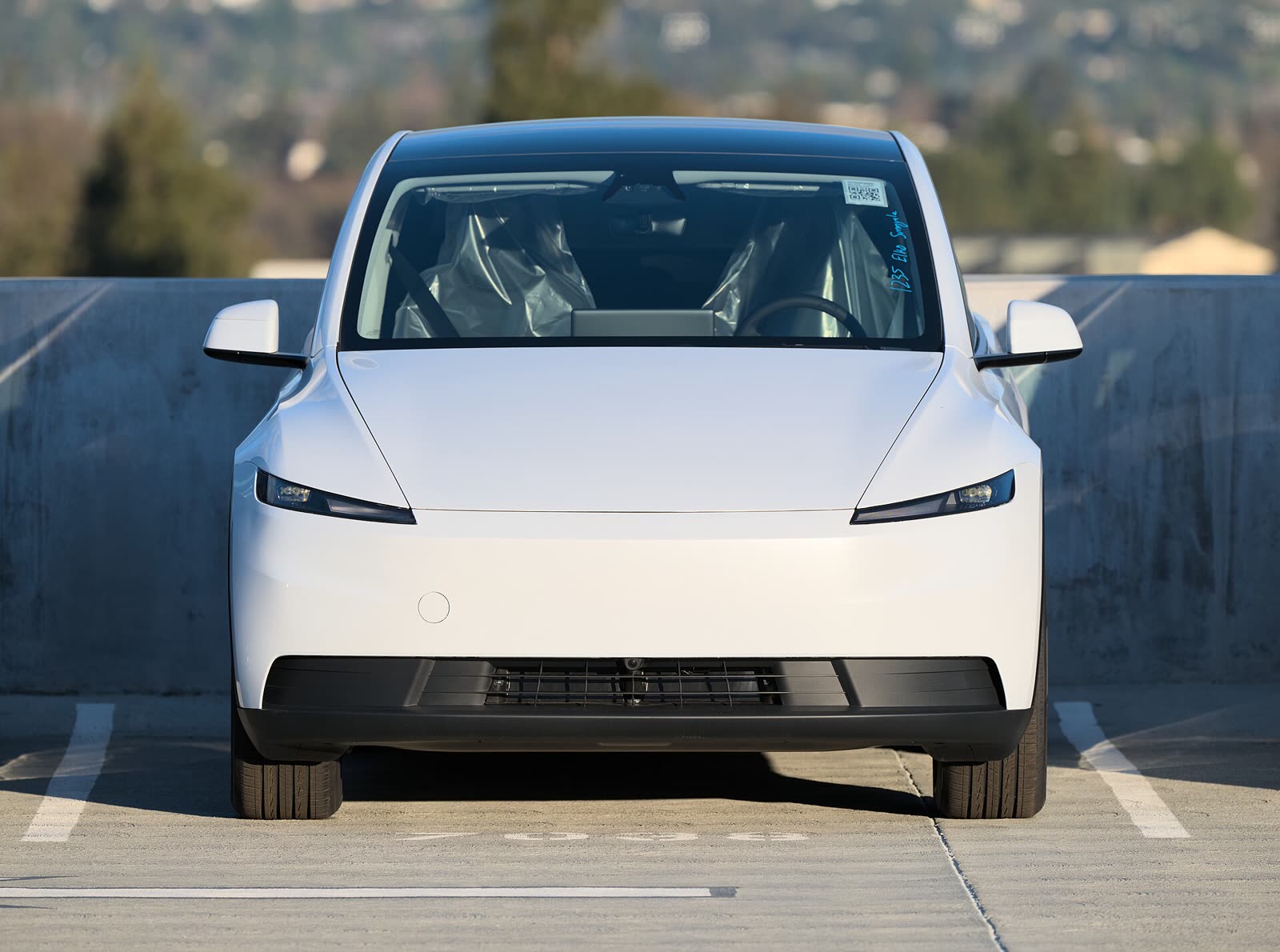
Tesla Model Y. Photo: Dllu, CC BY-SA 4.0
In Georgia, where the whole fleet is imported, this applies to any car with assistance systems, not only to Teslas: what matters is the trim of the specific car, not the model.
Full Self-Driving works differently — it is tied not to the car but to the market. It is not a part you can buy and fit, but a paid function in the car's software: Tesla unlocks it remotely and only where it has regulatory approval.
The entitlement is attached to a specific vehicle — to its VIN and to the market it was built for, not to the country it is driving through today.
A car from a country where FSD is not approved will never get it: neither relocation nor resale changes that. Cars built for Georgia itself do not exist either: Tesla is not officially sold or serviced here. There are no branded showrooms and no service centres in the country.
A Tesla imported from the US with FSD already paid for does not lose the function, but it works in the region it was approved for. What happens to it beyond that region Tesla does not describe publicly, and there is no evidence in open sources of FSD working for anyone in Georgia.
There is, however, a workshop in Tbilisi that services Teslas and offers FSD activation as a service. On the site of the service at 63 Beliashvili Street you pick it from the general list when booking a visit, next to navigation installation, battery replacement and key programming. No price is given, and there is no explanation of what the activation involves: a configuration change through a service tool, a reflash, or something else.
There is no public confirmation that FSD works on Georgian roads after such a procedure. The reviews contain none either: the two Tbilisi workshops that service Teslas hold 4.8 and 4.9 on Google Maps, but not a single visitor mentions FSD activation (as of 28 August 2026) — the reviews are about suspension repairs, prices and opening hours.
It is not only the autopilot that is tied to the market of manufacture. The built-in navigation fails for a different reason: the car carries the maps of the part of the world it was built for, and Georgia's are not among them. The navigation button on the screen stays grey and will not respond — this is not a connectivity problem and not a fault.
It has nothing to do with the autopilot: neither switches the other on or off. It does, though, affect everyone. An owner of a car imported from the US is left without navigation whether or not FSD was bought for it.
There is no single answer as to what to do about it. In January 2026, in a Tesla owners' community on Reddit, someone who had imported a Model Y from the US asked how to switch navigation on in Armenia, where — as in Georgia — there is no Tesla service. Two different stories came back. The first is from an owner who moved his car to a place that does have service:
I just imported my model Y that I had in the U.S. to the Middle East where I actually have a Tesla service center. And sorry to break it to you, there is no way to activate navigation outside of the U.S. Even when visiting the service center, they installed Middle East (ME) maps instead of North America (NA) in the software screen.
u/ir666, r/TeslaLounge
He adds that the navigation button did not work even after the maps were swapped, and that he ended up fitting a phone holder and using Google Maps. The second story is the opposite: another member of the thread converted his car to European specification and the maps started working.
Maps need to be switched to eu version. I had it done in Romania.
u/Thetechfo, r/TeslaLounge
This was a full conversion to European specification: his car drives in Europe, charges on European networks, and the maps work after the rebuild. He drove from Paris to Bucharest for it — he knows of no other place except Romania and Ukraine, and official Tesla service does not do such conversions.
For Georgia that is a hint rather than an answer. Whether European maps work in Georgia itself nobody in the thread tested: the Armenian owner could not get to Romania. The Tbilisi workshop offers navigation installation in the same list of services as FSD activation, but it has no confirmed results either.
| Function | Works in Georgia | What it depends on |
|---|---|---|
| Adaptive cruise control | Yes | The car's trim |
| Lane keeping | Yes, if the car has it | Market of purchase and model year |
| Full Self-Driving (Supervised) | No | Georgia is neither among the available countries nor among those awaiting approval |
| Third level of automation | No | Withdrawn by manufacturers in early 2026 |
| Built-in navigation of a US Tesla | No | The car detects that it is outside its region |
What assistance systems are missing in Georgia
Assistance systems see the road through cameras and radar, and they make decisions from the markings and the geometry of the lanes. The first thing they lack here is the markings. This is how a Tbilisi resident answered a question about driving in the country, asked in the city's community on Reddit:
No, many roads in city are badly planned/painted and no AI will understand what's going on at all, signs and markings are often lacking, invisible behind trees, or simply incorrectly placed. Lanes are often merging in incorrect ways.
u/Natural_Spell5957, r/tbilisi
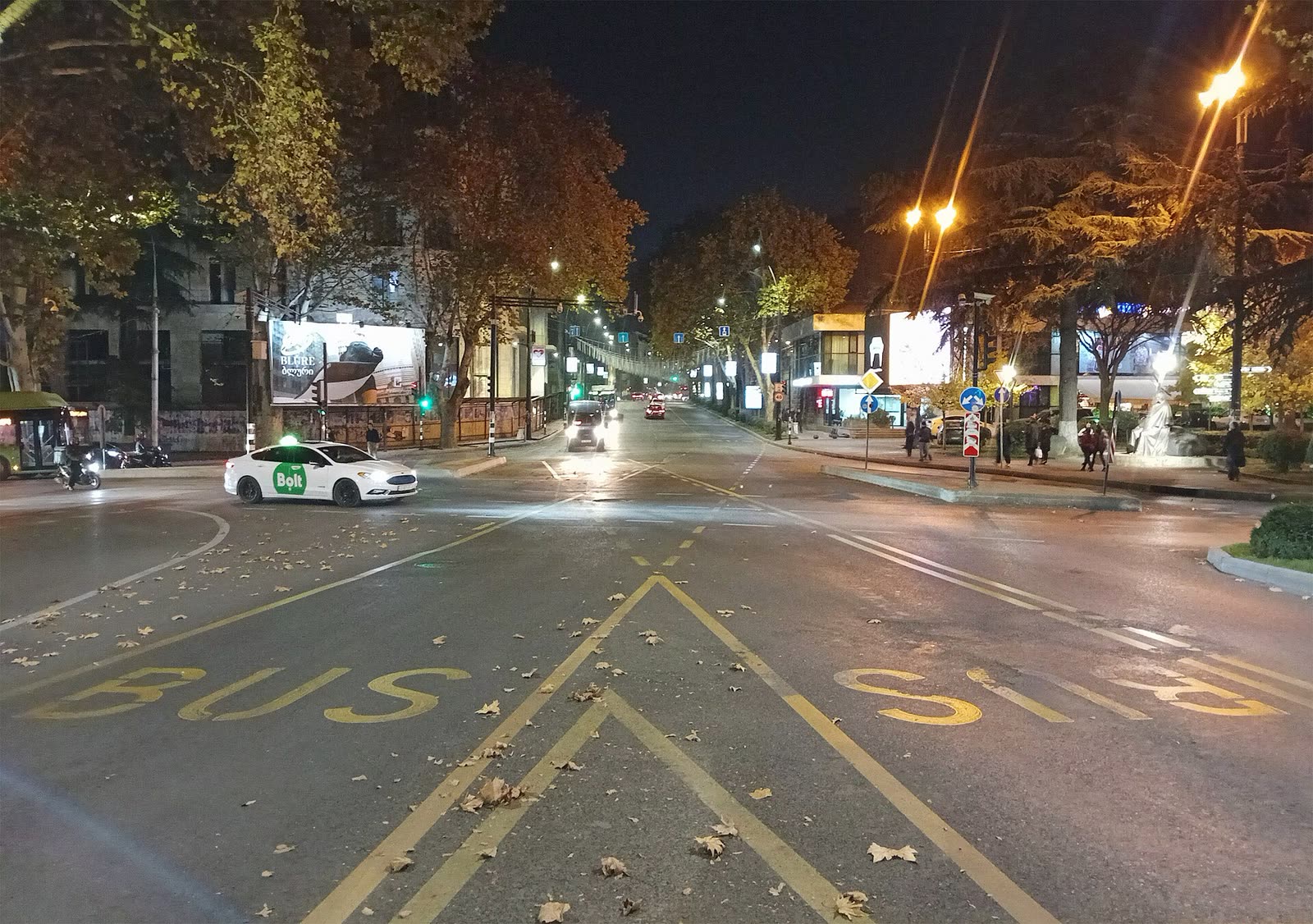
Markings on Chavchavadze Avenue in Tbilisi. Photo: Yuri Samoylov, CC BY-SA 4.0
The second difficulty is that traffic here runs on agreements between drivers. A visitor from Canada who drove around Tbilisi for ten days described the city's logic like this: nobody cares about lanes, single-lane roads carry two rows of cars, many junctions have no lights, and the order of passage is settled with a flash of the headlights and a look.
Biggest thing to get used to is people don't really care about lanes. There will often be 2 rows of cars on single lane roads. Many intersections are not light controlled, but surprisingly most drivers are fairly courteous and will flash or wave you through. If you see a gap, take it. Just maintain eye contact with the other drivers.
u/tsu1028, r/tbilisi
In that system an assistant is not a participant but an obstacle: a camera does not read eye contact. Where a local driver understands an intention from a glance and a gesture, the electronics see only an obstacle that is either there or not.
The third difficulty is the road network itself. UN Regulation No 157, under which automated driving systems are certified, allows them to operate only where oncoming traffic is physically separated. In Georgia that requirement is met by sections of the East–West highway, which have been gradually rebuilt to expressway standard since 2006; the rest of the network is ordinary undivided road.
The fourth difficulty is not covered by any rules at all — livestock. Cows and pigs in Georgia graze without fences and wander onto the carriageway: in the mountains, on intercity roads and even on the outskirts of Tbilisi. Asked by a newcomer why there are so many cows, the Tbilisi community on Reddit answered briefly:
people own cows. and pigs. they wander around.
u/leonilaa, r/tbilisi
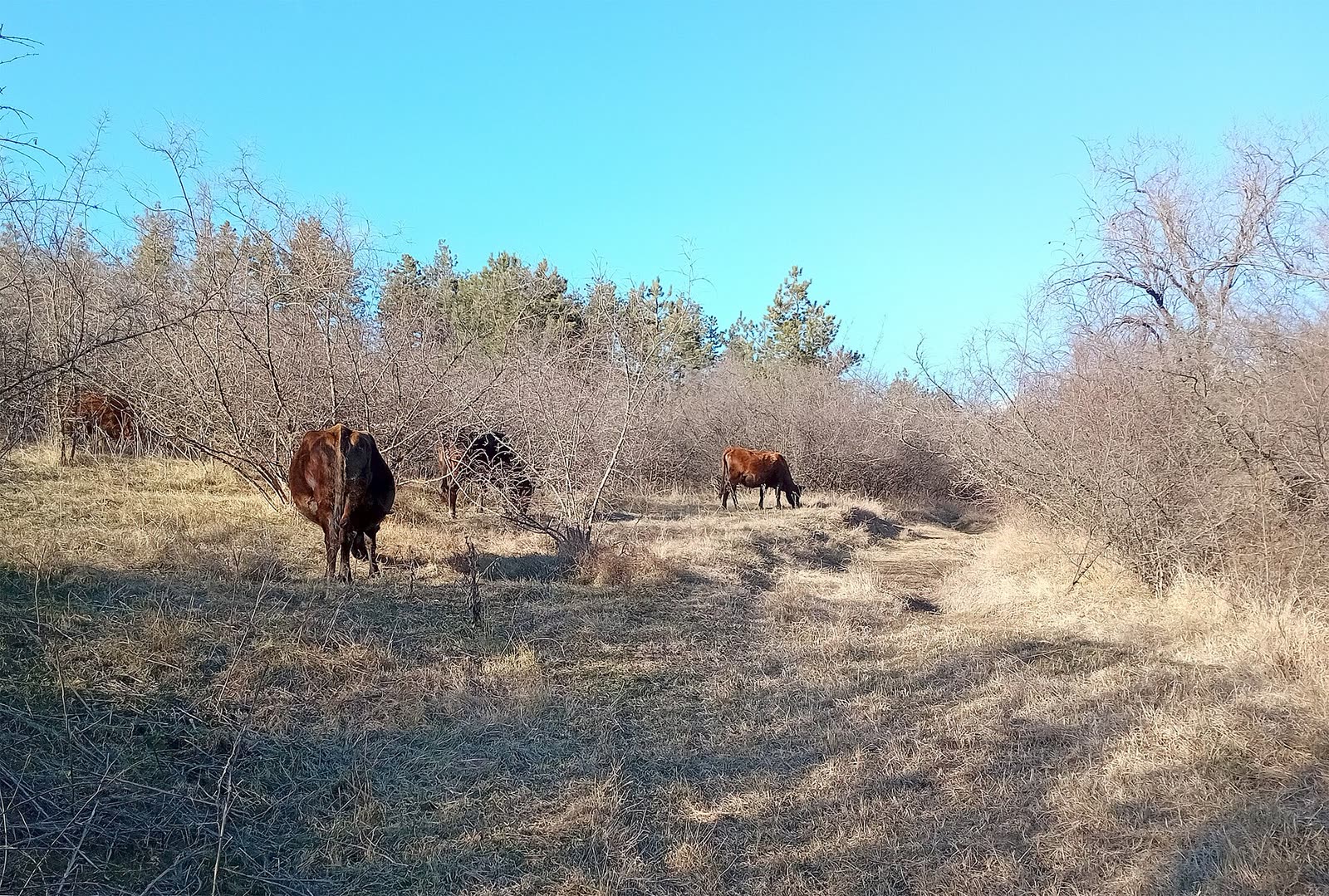
Cows beside a road above the Vere valley in Tbilisi. Photo: Yuri Samoylov, CC BY-SA 4.0
For a driver that means a cow may be standing on an empty straight road, and the braking will be because of her. An assistant will see such an obstacle and stop, but it cannot anticipate it the way a local driver does on a familiar stretch. How often this ends in a crash is unknown: there are no official figures.
The law does not know the word "autopilot"
Georgian legislation has no autonomous, automated or driverless vehicles — the concepts simply never appeared there. They are absent from the road traffic law, from the Criminal Code and from the Civil Code. For the law, a car with assistance systems is an ordinary car with a human behind the wheel.
The law defines the driver as the natural person operating the car and requires attention to the road from them. Article 21 of the road traffic law forbids doing anything unrelated to driving while the vehicle is moving. Article 33, on speed, adds a second requirement: the chosen speed must allow the driver to keep the car under control at any moment.
The same Article 21 holds the phone rule: you may not hold a phone at the wheel, and you may talk through a headset or speakerphone provided both hands stay free for driving.
International rules do not change the picture. Georgia has been a party to the Vienna Convention on Road Traffic since 1993. Since March 2016 systems that influence control have been recognised as lawful, provided the driver can switch them off or take over manually at any moment. Since July 2022 the convention has a separate article on automated driving, but it applies only where national technical rules and operating legislation have been adopted. Georgia has not adopted them, so a moving car must still have a driver.
In a crash it is the human who answers. Article 276 of the Criminal Code names as culpable "the person operating the vehicle" and provides for no other option. Under the Civil Code the owner of the car is liable as well for harm caused by it — even if someone else was driving. Only force majeure releases them.
The maker of the assistance system is not liable for the crash itself: under Georgian law the fault for an accident lies with the driver in any case. A different claim can be brought against the manufacturer — under the rules on liability for a defective product, if the system malfunctioned and caused damage. Even there the maker has a defence: it is not liable if the defect could not have been detected at the level of science and technology existing when the product was released. How that rule works with driver assistance systems is unknown: no rulings by Georgian courts on such claims are publicly available.
Frequently asked
Does Tesla's autopilot work in Georgia? Full Self-Driving does not: Georgia is neither on the list of countries where it is available nor on the list of those where Tesla is awaiting regulatory approval. Adaptive cruise control and lane keeping do work, if the particular car has them.
What does the "FSD activation" offered in Tbilisi involve? The workshop on Beliashvili Street offers the service when you book a visit, but does not say what it consists of and does not publish a price. There is no confirmation, from the service or in reviews, that FSD works on Georgian roads afterwards.
Can I rent a car with assistance systems in Georgia? Yes. The AutoHub fleet has premium cars of recent years — BMW X5 and X7, Mercedes-Benz E-Class and G-Class, Land Rover Defender, Lexus LX — where adaptive cruise control and lane keeping are part of the base trim. The concierge will confirm which systems a particular car has before you book.
Who is liable if a crash happens with an assistant switched on? The driver. The law recognises only the natural person operating the car, and rental contracts and insurance rules do not mention assistance systems at all.
Can I be fined for taking my hands off the wheel? There is no separate fine for that in Georgian law. There is the requirement to keep the car under control at all times, and a 50 lari fine for holding a phone.
Does the navigation work in a Tesla imported from the US? As a rule, no: the car detects that it is outside its region and the navigation button stays inactive. Some owners solve it by having the car converted to European specification at independent workshops.
Should I rely on lane keeping on the Georgian Military Road? No. There are hairpins, tunnels, a stream of lorries and overtaking into oncoming traffic, and the markings are not everywhere.
The bottom line for a driver is simple. Full Self-Driving will not switch on in Georgia in any car. Adaptive cruise control and lane keeping work if the car itself has them, but they cannot be relied on everywhere: on worn markings and in city traffic they hand control back. Responsibility for the drive lies with the person at the wheel in any case.
If you want a car where the assistance systems work as intended, the fleet has premium models of recent years. In Tbilisi they are delivered in about half an hour, and for the first days in local traffic you can add a driver. Message the AutoHub concierge on WhatsApp or Telegram at +995 557 437 034, or write to concierge@autohub.ge.
On the cover — Chavchavadze Avenue in Tbilisi. Photo: Andrew Milligan sumo, CC BY 2.0.