 Alexander wan2ted Evsin
On 2 April 2026 importing a car older than six years into Georgia became more expensive, and importing one older than thirty became cheaper. A petrol car older than six years is charged an excise of ₾4.5 per cubic centimetre of engine capacity instead of the previous ₾0.80: OC Media counted a nearly sixfold rise in customs clearance costs. The same car, once it turns thirty, is charged ₾1.
Because of that gap, importing a 1980s Volga costs less than importing a ten-year-old Mercedes with the same engine. This article covers where to see collector cars in Georgia, what it costs to import one, and why there are so many of them here.
The museum, Tbilisoba and club meets: where can you see collector cars?
Almost all collector cars in Georgia are in private hands, and most of them are rarely seen in public. You can find them at the museum, at the autumn festival and at club meets.
The classic car museum. The collector Giorgi Mamulashvili created it and opened it on 25 October 2014, during Tbilisoba, with twenty-five cars on display. The collection has grown since, so there is no exact count: two halls currently hold up to fifty cars and ten motorcycles.

Almost all the cars are Soviet, and what makes them interesting is the history of the individual car:
- a 1947 Pobeda phaeton, the exhibit people ask about most;
- a black GAZ-M1 that the museum calls Lavrentiy Beria's car;
- a 1978 GAZ-14 Chaika from Eduard Shevardnadze's official fleet;
- a 1977 GAZ-13 Chaika that belonged to the Patriarch of All Georgia;
- a GAZ-M1 Emka and a GAZ-4 pickup added in 2017: about five of them survive worldwide, according to the museum;
- a 1928 Ford Model A that, according to the museum, was used during the filming of the 1967 Bonnie and Clyde.
Three models in the collection are what most people come for:
The Pobeda (GAZ-M20), built from 1946 to 1958. The first Soviet car designed after the war and the first with a body of its own rather than a licensed copy. The Gorky plant built just under 236,000 of them, of which about 14,000 were open cars, which is why visitors stop at the Tbilisi phaeton more than at anything else in the hall.
The Chaika GAZ-13, built from 1959 to 1981. You could not buy one. Chaikas were state property: they were issued to ministries, embassies and senior officials and taken back when the post changed. Only a few thousand were built in twenty-two years, so few survive, and the museum's example is valuable because it belonged to the Patriarch of All Georgia.
The Chaika GAZ-14, built from 1977 to 1988. The larger, squarer successor to the GAZ-13 and the last Chaika. The plant stopped building them in 1988 and no new Chaikas have been made since, so few examples survive. The museum's example is presented as a car from Eduard Shevardnadze's official fleet.
Beside these rare examples stand mass-production cars: Volgas from taxi fleets, Zhigulis families kept for thirty years, Moskviches.
The museum is in the Isani-Samgori district at 7 Avtomuzeumis Street, open Tuesday to Sunday from 11:00 to 18:00. An hour is enough to walk through it. It is about fifteen minutes from the centre and awkward to reach by public transport, so many tourists never get there and the halls are almost empty on weekday mornings. On Google Maps the museum holds 4.8 out of 5 from 1,049 reviews. A guided tour comes with the ticket: reviewers write that the director himself walks visitors through the halls and tells the story of every car in Russian or English. A workshop in the yard is where those cars are restored. Look around on the way: old Zhigulis and Volgas still stand and drive in the courtyards of Isani and Samgori.
The car show at Tbilisoba. Tbilisoba is the city's own holiday, also dedicated to the harvest: it has been celebrated since 1979, usually on the first weekend of October, with fairs, processions, concerts and sporting events in Rike Park, on Orbeliani Square and in Abanotubani. The dates move sometimes: in 2025 the festival was held on 20–21 September because of the elections. A retro car show is not on the programme every year, so it is worth checking in advance. When the car show does run, owners bring cars out of private collections and park them alongside the modern brand stands. Entry to the festival is free.
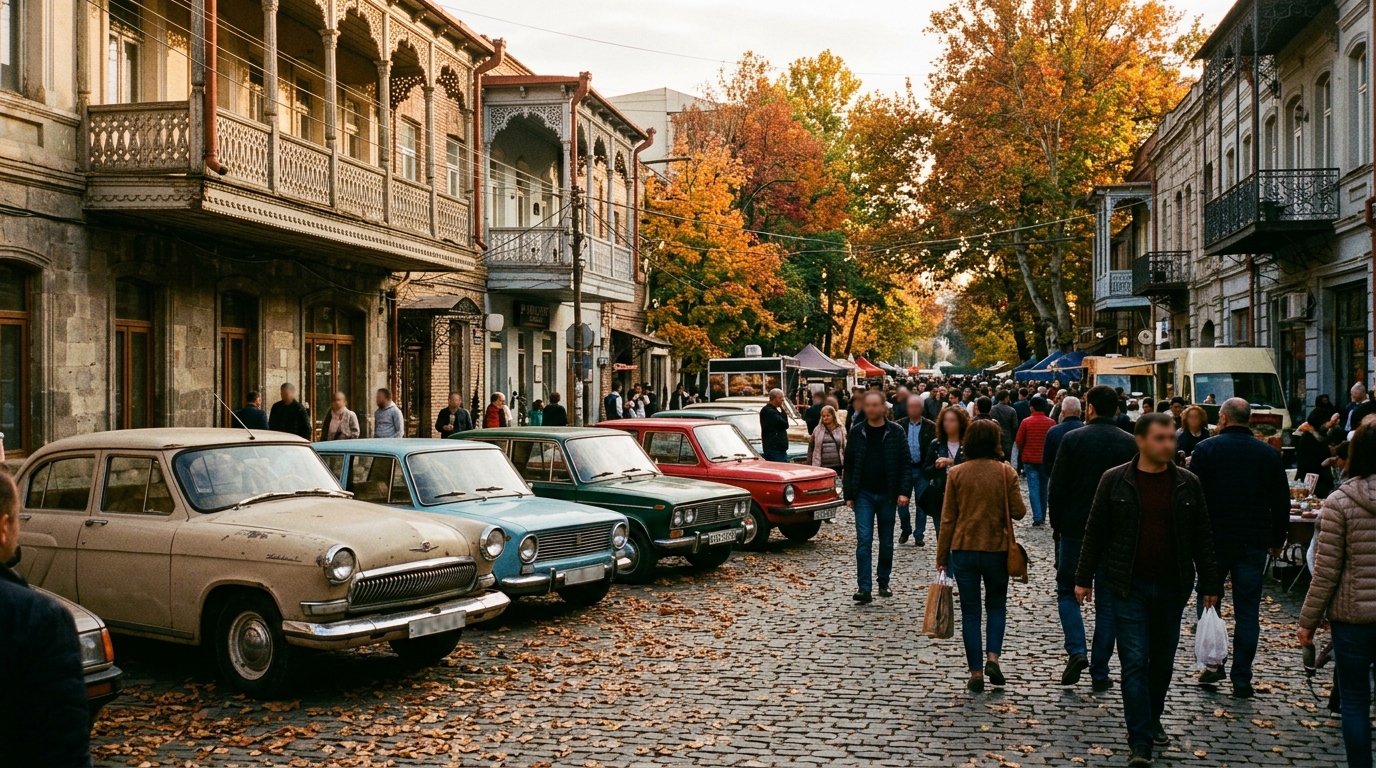
The centre is closed to traffic during the festival, so leave the car outside the cordon and walk in. Cars are usually put out closer to midday; Rustaveli is better before the afternoon crowd builds.
Club meets. These are run by clubs rather than promoters: gatherings in Poti, in Telavi, in shopping centre car parks outside Tbilisi. Dates shift every year and are announced on Instagram and Facebook, not on ticketing platforms. The Historic Vehicle Association of Georgia is behind a good share of it.
In Europe such meets bring out pre-war classics and rare sports cars. In Georgia those barely turn up — an r/tbilisi user described what stands there instead:
"Check Oldtimer Club Georgia on FB, you will understand, that majority sees old timers as old German sport sedans, American ponycars and wedding cabrios"
u/giorgiblr, r/tbilisi
It is worth following the club pages in advance: five days' notice before a meet is normal here.
Plenty of old cars, dozens of collector ones
According to Geostat, 1.9 million vehicles are registered in Georgia, and more than 1.6 million of them are over ten years old — more than eight cars in ten. Between January and October 2025 more than 93,000 used cars worth 2.3 billion dollars were shipped out of Georgia, mostly to Kyrgyzstan, Kazakhstan, Azerbaijan and Armenia. Repairs here are cheap, and until April 2026 it paid to buy damaged cars abroad and rebuild them locally. In April 2026 someone asked on r/tbilisi where all the newer Mercedes, BMWs and Porsches in Tbilisi come from, given local salaries. The replies explained how those cars get here:
"Most of these cars, if not all of them, are totaled/crashed/sunken/stolen ones that coming from America on the big ships, lots of them, and questionably 'restored' by locals because of cheap labor. It is kind of national industry lol."
u/NiFiGaS, r/tbilisi
In the same thread an Italian who brought a car into Georgia and rebuilt it here gives a figure — around 16,000 dollars for everything. At home, he says, it would have cost two to three times more.
Collector cars arrived the same way. The same ships, workshops and mechanics brought in and revived older cars, and they still do: a commenter on r/tbilisi writes that 1970s Mercedes SLs are still bought as salvage in the United States and rebuilt here to be rented out for weddings.
Collector cars are a small part of that, though. An r/tbilisi user who rents out his own 1979 Cadillac Fleetwood for weddings and other events described that market in a single comment:
"Based on my experience, i can say that there are dozens of retro cars in Georgia, but the market is so small that there is not enough demand for retro cars even for renting them, as this business is characterized with seasonality. However, as time passes, retro cars price spikes and is more demanded, but more time means more repairment costs."
u/Teuto_Burg, r/tbilisi
The market is small: dozens of cars rather than hundreds, and by the Cadillac owner's account there is not even enough demand to rent them out. What income there is comes seasonally, mostly from weddings — what such a day costs is covered in the wedding cortege guide. It is not a living: classics rise in price over time and repairs get more expensive too.
On auto.ge (as of 25 August 2026) 5,343 cars were listed for sale, and only 45 of them were built in 1996 or earlier. Almost half of those forty-five are Mercedes-Benz. Ford, BMW, Chevrolet and Porsche account for three or four listings each, and the other makes for one or two. In the rental section, one car out of 903 was thirty years or older.
Excise, duty and VAT: what does importing cost?
At the border you pay for the engine and the age of the car, not for the car itself. The main payment on an old car is the excise: it is charged not on the purchase price but on engine capacity, and the rate per cubic centimetre depends on how old the car is. Since 2 April 2026 it looks like this:
| Car age | Excise per cm³ | What changed |
|---|---|---|
| Up to 6 years | ₾1.5 | unchanged |
| Older than 6 years | ₾4.5 | was ₾0.80 |
| 30 years and older | ₾1.0 | the lowest rate in the table |
The rates come from the customs calculator used by importers. Right-hand-drive cars pay triple the base rate, left-hand-drive hybrids get a discount. Duty and VAT are charged on top of the excise; how those payments stack up for modern expensive cars is covered in the ownership maths article.
The lowest rate in the table belongs to cars thirty years and older. Importing one costs less than importing a new car.
The rules change often, and locals get them wrong too. Here is a comment from r/tbilisi:
"Georgian legislature is wildly unreliable when it comes to importing vehicles. They change it almost every year. Now importing cars older than 6 years is prohibited, but allowed if it's older than 30. I'd look into this in the first place"
u/gsani-, r/tbilisi
A ban on cars older than six years was proposed and then replaced by the higher excise. Since 2024 there has been one more requirement — the Euro 5 emissions standard. A 2013 model year or newer meets it. Without that, Georgian plates are not issued. Cars thirty years and older were exempted from Euro 5, and the excise on them is lower. So a 1994 car can be registered and a 2011 car cannot.
The gap between engines is considerable. A 1.5-litre Zhiguli at ₾1 per cm³ works out at about ₾1,500 of excise; an American 5.7-litre V8 of the same age at about ₾5,700, and that is before duty and VAT. The condition of the car does not affect the calculation.
Restoration: what is cheap here and what is not?
Damaged cars are shipped here precisely because of the repair costs: bodywork, paint and mechanical rebuilds in Georgia are far cheaper than in Europe or the United States. What is cheap is hand work: panel beating, welding, painting, engine assembly. A full restoration with original parts is another matter. There is no shortage of workshops, and waiting lists are normal, as an r/tbilisi user reports:
"Regular car restoration/modification startups do pretty well(I had to wait in line for several days)."
u/TopturoApturo, r/tbilisi
The car services section of auto.ge (as of 25 August 2026) holds 778 listings: 60 of them mention panel work and 16 mention painting, while the word "restoration" appears in only three. A search for classic-car restoration in Tbilisi on Google Maps returns body shops and detailing studios, with no dedicated classic-car workshop among them. Bodywork is a mass-market service here; restoration as a trade of its own barely exists. The prices are low too: a member of the DRIVE2 car owners' community paid 800 lari, about 320 dollars, for a full respray of a sedan and waited two weeks.
The r/tbilisi user who rents out his 1979 Cadillac Fleetwood for weddings praises the quality in the same r/tbilisi thread: in his words Georgia has plenty of professionals he would trust with his own cars. The difficulty starts with rare models — here is another r/tbilisi user on that:
"And selling Jag XJS is the half of the job, how to service it? I knew some people who have her in necro-premium condition and always wanted one myself, however maintenance is the thing"
u/giorgiblr, r/tbilisi
The same goes for anything that cannot be made by hand on the spot. The early fuel injection systems that replaced carburettors in the 1970s and 1980s need both a specialist and original parts. Factory upholstery cannot be re-stitched here either, so it is shipped in. Bodywork and mechanics are cheap here; the restoration budget goes on parts and electronics.
Frequently asked
Where can I see classic cars in Tbilisi? The classic car museum on Avtomuzeumis Street, Tuesday to Sunday, 11:00 to 18:00. About fifty cars and ten motorcycles, mostly Soviet.
Is there a classic car festival in Georgia? Several club meets through the summer, and in some years a car show at Tbilisoba in October. Dates change every year and are announced on social media rather than ticketing platforms.
When is Tbilisoba? In October, in central Tbilisi, usually on the first weekend of the month. The city holiday has been held annually since 1979, and city hall announces the exact dates each year.
Why does Georgia have so many old cars? Cheap repairs, fast registration and decades of importing damaged cars from the US and EU to rebuild locally. Since 2 April 2026 the excise on cars older than six years has risen from ₾0.80 to ₾4.5 per cm³, which is reshaping the market.
Is it cheaper to import a car thirty years or older into Georgia? By tariff, yes. Such cars pay excise at ₾1 per cm³ against ₾4.5 for cars older than six years, with duty and VAT on top in both cases.
Are cars older than six years banned from import? No. A ban was proposed in early 2026 and replaced by the higher excise. Separately, Euro 5 is required for registration, which in practice means a 2013 model year or newer, and cars thirty years and older are exempt from it.
What should I check before buying an old car here? Age does not mean restoration: the same rebuilding culture that filled the roads with cheap premium metal also produces cars that look better than they are. Have the car inspected independently, and work out the customs bill in the official calculator before you go and see it, not after.
Can I rent a classic car in Georgia? A small number of owners rent classic cars for weddings and other events, mostly seasonally. Ordinary rental fleets are modern — which expensive models you can actually book in Tbilisi is collected in the celebrity car guide.
Is restoration work in Georgia any good? Bodywork, paint and mechanical rebuilds are well regarded and cheap by European standards, and the waiting lists confirm it. The difficulty starts with electronics and rare parts.
How much does the museum cost? A ticket costs 10 lari and the guided tour is included — that is the price visitors have been quoting in reviews for the past three years. The museum publishes no rate of its own, so call ahead before making a special trip.
The cars in our fleet are modern. In Tbilisi they are delivered in about half an hour, to your hotel or to the airport. Where to take them: track days in Rustavi and routes around Batumi.
You can message the AutoHub concierge on WhatsApp or Telegram at +995 557 437 034, or write to concierge@autohub.ge. Name the model and the dates: documents and the deposit are checked before delivery, and any car can come with a driver.