 Alexander wan2ted Evsin
The Armenian border sits 80 kilometres from Tbilisi, down the highway through Marneuli. The Sadakhlo-Bagratashen crossing works around the clock, and the queue on a normal day takes 30 to 60 minutes. Rental cars cross it every day, but only the ones whose drivers asked the rental company for one specific document a week before the trip.
The three other neighbours are out of reach in a rental car. Azerbaijan's land borders have been closed to passenger entry since March 2020, and the latest announced reopening date is October 1, 2026. For Turkey and Russia rental companies issue no cross-border permit at all.
This guide covers the whole procedure: which documents the rental company prepares and what they cost, what you buy on the Armenian side, what the border fees add up to, and how long the road to Yerevan takes. It also explains why the "Azerbaijan permit" some listings advertise is not worth the paper.
Where a rental car can cross the border, and where it cannot
Georgia has four land neighbours: Armenia, Azerbaijan, Turkey and Russia. Of those four countries only Armenia is open to a rental car. The bans on the other three come from different sides: one border is closed by a government, the two others by the rental companies.
A trip to Armenia takes two documents:
- A notarized cross-border permit, issued by the rental company. Preparing it takes about a week.
- Armenian third-party insurance for 15 to 20 dollars, bought at the border.
Without those two documents the car is not let through at the border post. The Armenian policy is required because the Georgian one stops working the moment you leave the country. We covered how the policies differ, and what the rental price includes, in the piece on Georgia's mandatory entry insurance.
The paperwork is the rental company's job, and the renter only has to ask for it about a week ahead. After that the question is no longer about documents: Armenian traffic rules apply across the border, and the drive to Yerevan takes several hours. If driving it yourself is not the plan, there is the car with a driver, though the cross-border terms are still agreed before booking.
Where the road ends
Azerbaijan is closed by a government decision. The country shut its land borders to entry in March 2020 over the pandemic and has extended the closure ever since: the current announced date is October 1, 2026, as OC Media reports. Rental companies still issue permits for the country, and StarCar lists Azerbaijan among the available destinations alongside Armenia. Such a permit is worth nothing right now: there is no entering the country by land, in a rental or in your own car. What remains is the plane and the Tbilisi-Baku train, running again since May 26, 2026, as Eurasianet reported. There is no road from Armenia into Azerbaijan either: that border is closed outright.
Turkey and Russia are closed by the rental companies. StarCar lists the countries it issues cross-border permits for, Armenia and Azerbaijan, and states that no such permit exists for Turkey or Russia. The Georgia guide Wander-Lush and the TripLinkHub guide say the same. Turkish import rules are not the obstacle: a rented foreign-plated car may stay in Turkey for the term agreed in the rental contract, according to the Turkish law firm CANAYDIN. The limit is set on the Georgian side, because the rental insurance ends at the border.
For Turkey there is a way around it: drive to Batumi, return the car, walk across the Sarpi checkpoint and pick up a Turkish rental in Hopa or Trabzon. The driving-in-Georgia guide suggests the same route.
Why rental companies dislike border runs
No rental company in Georgia grants open-ended cross-border use, and the reason is the same everywhere. The rental insurance ends at the border post: CASCO and third-party cover from the contract apply on Georgian territory only. An accident abroad is an uninsured loss for the company, so every trip is arranged in advance and for a named country. Industry guides and the rental terms themselves say the same thing.
Since the exit is arranged in advance, its proof is a document too: what you hand over at the post is the permit, not a chat with a manager. So the trip has to be agreed in writing, and before the booking is paid. A guide to crossing borders in a Georgian rental gives the same warning:
Insist on written confirmation before you book. Verbal promises are worth nothing at a checkpoint.
MYDRIVE, guide to crossing borders in a Georgian rental
The documents you need and what they cost
The cross-border permit is issued by the rental company in Tbilisi, and the Armenian insurance is bought past the border post. Drivers without Georgian residency are also required to produce a guarantee letter at the Armenian post.
Arranging it with the rental company
Armenian border officers let someone else's car through only with a notarized authorization from the owner. A renter cannot produce that document: the owner signs it, and the owner is the rental company. The request goes in when you book. StarCar asks for at least a week to prepare the permit. The international chains handle exits by advance written request: Enterprise has a separate procedure, and Alamo even lets you pick the car up in Georgia and hand it back in Armenia.
What local companies charge for the permit differs noticeably. A traveller in the Georgian community on Reddit compared his agency's quote with the going notary rate:
According to Google, 100 gel is €33. That’s less than half the price the rental agency told us.
u/water_fountain_, r/Sakartvelo
People in the same discussion put the price of the notary work itself at 80 to 100 lari. Anything above that is the company's fee for preparing the document and taking it to the notary.
Insurance and fees on the Armenian side
Armenia requires local third-party insurance for every vehicle, rentals from Georgia included. It is sold right past the crossing: insurance kiosks stand about a hundred metres from the post. A short policy for the length of the trip costs 15 to 20 dollars. Drive without it and the first Armenian patrol writes a fine.
Drivers without Georgian residency face one more payment at the Armenian post. They are asked for a letter of guarantee stating that the car will come back to Georgia rather than be sold in Armenia. A Reddit user who crossed in someone else's car recounts that requirement:
If you are not Georgian resident you will also have to get a letter of guarantee/insurance on the border that you will return the car and not sell it in Armenia. It will cost you 100 lari.
u/Vladvic, r/Sakartvelo
There is no official public price list for these border charges, and the sums are quoted on the spot. According to people who have driven this crossing, the kiosks at the border do not always take cards, so a cash reserve is safer.
What is paid, and to whom
The permit is paid to the rental company in Tbilisi; the insurance and the guarantee letter are paid on the Armenian side of the border.
| Item | How much | Who collects |
|---|---|---|
| Cross-border permit | From zero to ~80 euros, depends on the company | Rental company |
| Armenian insurance | 15-20 dollars | Kiosk past the crossing |
| Guarantee letter for non-residents | ~100 lari, per drivers who crossed | Armenian post |
The rental price is not part of these costs. The border needs cash only: 150 to 200 lari covers the insurance and the guarantee letter. The rental deposit is counted separately, and it is covered in detail in the piece on deposits and excess.
How long the drive to Yerevan takes
Tbilisi to Yerevan is about 280 kilometres, with two border posts standing in the middle of that distance. The 73 kilometres to the crossing take roughly an hour and a half, and the remaining 201 kilometres from Bagratashen to Yerevan another three and a half. With the border formalities the trip comes to 5 or 6 hours.
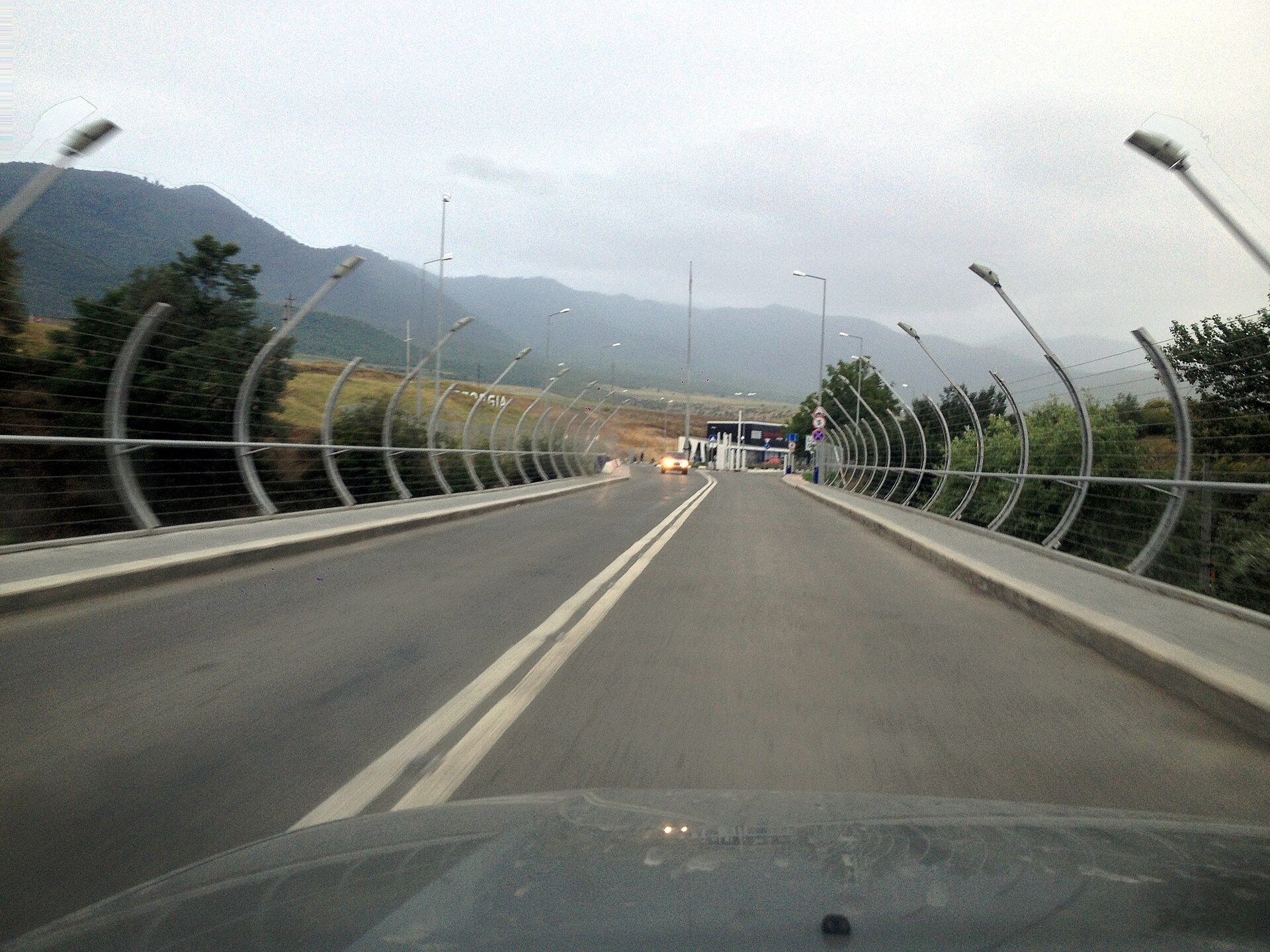
The bridge over the Debed river between the Sadakhlo and Bagratashen posts. Photo: Dalibor Z. Chvatal, Wikimedia Commons
Sadakhlo-Bagratashen works around the clock and remains the main road crossing between the two countries. The car passes two posts in a row, and each checks its own set of documents:
- Georgian post: passport, driving licence, the car's registration, the rental contract and the cross-border permit.
- Armenian post: passport control and temporary import of the car on that same permit.
- Kiosks past the post: Armenian insurance and the fees.
The queue on a normal day runs 30 to 60 minutes and stretches up to two hours in high season, which makes it the main variable of the whole trip and sets the departure time: leave in the first half of the day and the mountain stretch of the Armenian road is driven in daylight even after a two-hour queue. For routes through Javakheti there is a second crossing, Ninotsminda-Bavra, but the main flow goes through Sadakhlo. On the way back the document set is the same: without the permit the car will not be let into Georgia, just as it would not have been let out of it.
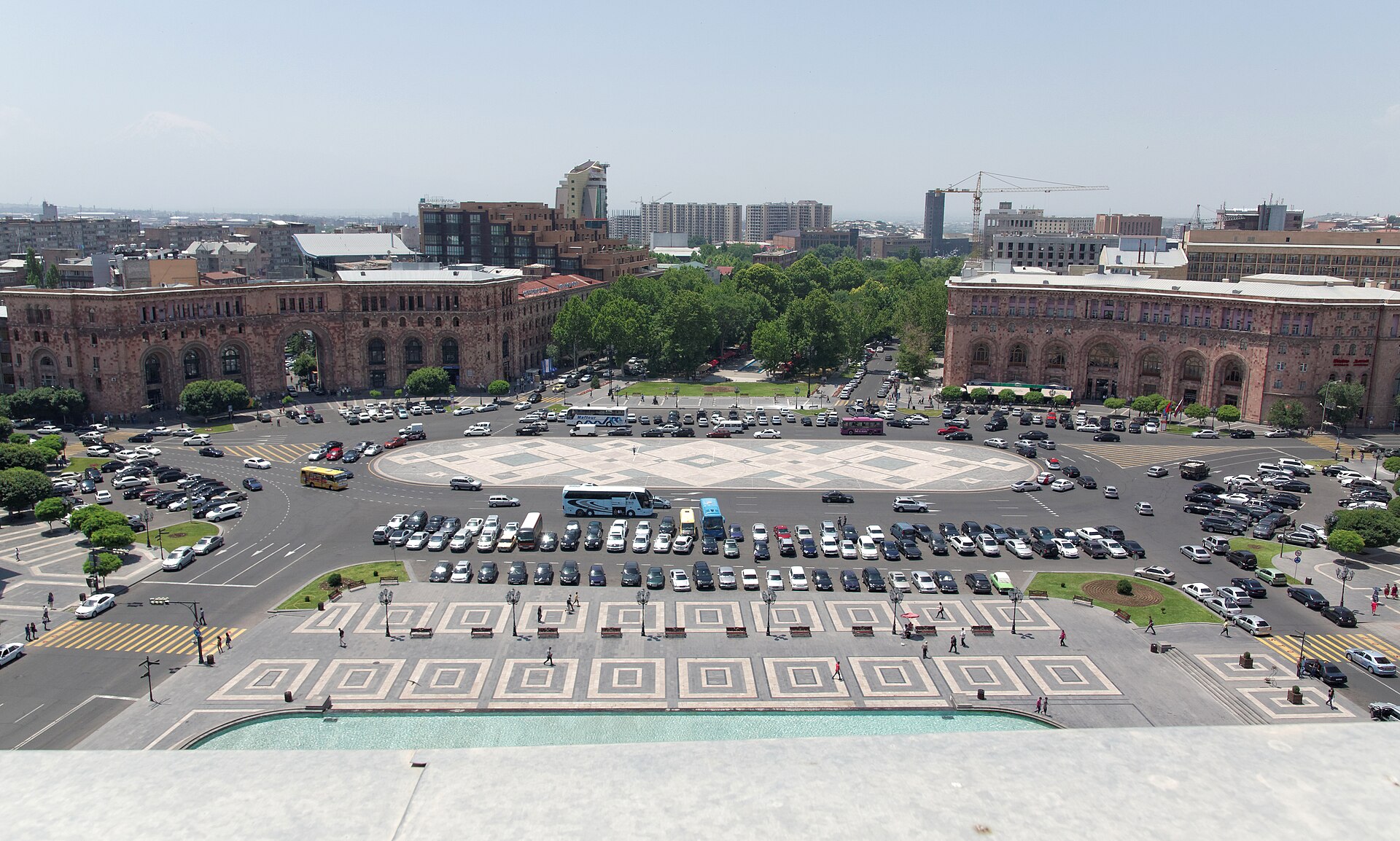
Republic Square, the centre of Yerevan and the end of the route. Photo: Vyacheslav Argenberg, Wikimedia Commons
Armenian road rules: what changes after the border
The rules across the border look like Georgia's, with three differences worth learning before the first encounter with a patrol.
- Alcohol. Drink driving in Armenia is punished up to a one-year licence suspension (article 126 of the Armenian Code of Administrative Offences). Reference sources give different permitted thresholds, so the only safe option in another country is not to drink before driving at all.
- Speed limits. The reference points are 60 km/h in town and 90 km/h on highways. In town the limit is the same as in Georgia, while outside town the Armenian one is higher: Georgian ordinary roads allow 80 km/h, with 110 km/h only on motorways. The road signs on the spot are what counts either way.
- Cameras. Yerevan runs noticeably more automatic cameras than Armenia's intercity roads do, and the tickets arrive by mail weeks later. In a rental such a fine catches up with the company back in Georgia and gets rebilled to you after the trip, the same way Georgian fines do.
Children under 12 are not allowed in the front seat in Armenia, and front seat belts are mandatory. Both rules match the Georgian ones, so no habits need changing. What differs is the price of a mistake. In Georgia going 15 km/h or more over the limit costs 50 lari, and over 50 km/h costs 300 lari. Armenia runs a different scale: 20,000 drams for 11-30 km/h over, 25,000 for 31-50 and 29,000 for 51-80 (article 124.4 of the Code of Administrative Offences).
If an accident happens in Armenia
The policy bought at the border covers only your liability to other road users. Damage to the rental car itself is not insured outside Georgia, so the repair bill lands on the renter. The sequence for any accident is therefore fixed: police, photos from every side, a call to the rental company before the car is moved. How the same sequence works inside Georgia is covered in the piece on accidents in a rental car.
Border rules and border charges in this region change often. Confirm the terms with your rental company in writing before the trip, and check what the crossing asks for on the day.
Questions people ask before the trip
How much is Armenian insurance at the border? 15 to 20 dollars for a short policy covering the trip. The kiosks stand about a hundred metres past the crossing, and cash is the safer way to pay.
Is the Sadakhlo-Bagratashen crossing open at night? Yes, 24 hours. The queue on a normal day is 30 to 60 minutes.
How long is the drive from Tbilisi to Yerevan? About 280 kilometres: an hour and a half to the border, three and a half after it, plus the queue at the crossing. The whole drive takes 5 to 6 hours.
Can I drive into Azerbaijan right now? No. The land borders are closed to entry, with October 1, 2026 as the announced reopening date. The plane and the Tbilisi-Baku train remain.
Can I drive from Armenia straight into Azerbaijan? No, that border is closed completely. The way back runs through Georgia.
Can I pick up a car in Tbilisi and drop it in Yerevan? Picking the car up in Georgia and handing it back in Armenia is possible at some international chains, Alamo among them. Local companies expect the car back where you took it, so ask when booking.
How much can I drink before driving in Armenia? Nothing. Drink driving carries up to a one-year licence suspension, and reference sources disagree on the permitted threshold, so it is not worth the risk.
What happens if I drive to Armenia without the permit? You will not reach Armenia: without the owner's notarized authorization the car is stopped at the Georgian post already.
Does the rental insurance work in Armenia? No. CASCO and liability cover from the contract apply on Georgian territory only, and Armenia requires a local policy. How the policies work inside Georgia is covered in the piece on mandatory entry insurance.
If the route starts in Tbilisi, there is no need to collect the car from an office: the AutoHub fleet holds 74 cars from 85 dollars a day, insured and with no card deposit, and delivery brings one to any point of Tbilisi in about half an hour.
Discuss a border trip with the concierge before booking: write on WhatsApp or Telegram at +995 557 437 034 or to concierge@autohub.ge, name the model, the dates and the route, and the exit documents will be checked before the car is delivered.
Cover photo: Dor Shabashewitz, Wikimedia Commons