 Alexander wan2ted Evsin
In Georgia a child under three may legally ride in the back seat of a car on an adult passenger's lap. No child seat is required: the law provides for this way of carrying a child explicitly.
On 5 August 2026 the government of Georgia approved a national road safety strategy through 2030. Mandatory child seats for pre-school children are one of the changes planned in it.
This article covers how many people die on Georgian roads, in which regions and through which violations crashes happen, what the rules require today, what is to change by 2030, and how the previous strategy ended after setting the very same target.
How many people die on the roads
Two agencies count crashes in Georgia differently, and the totals differ elevenfold. The National Statistics Office publishes every registered incident, including those recorded under the Code of Administrative Offences: 65,942 of them in 2025. The Ministry of Internal Affairs publishes only incidents registered under the Criminal Code: 5,969 of them in 2025. Both the strategy and its evaluation are built on the ministry's count.
In those 5,969 crashes 469 people were killed and another 8,191 were injured. Compared with 2019 the number killed is down by 2.5% and the number injured is up by 3.4%. Compared with 2023 the number killed is up by 6.1% and the number injured by 12%.
Per head of population, Georgia had 12 road deaths per 100,000 inhabitants in 2024. That is roughly 2.7 times the European Union average: around 19,800 people died on EU roads that year, or 44 per million inhabitants. Both figures come from the final evaluation of the previous strategy, published by the Ministry of Economy and Sustainable Development of Georgia in June 2026.
The same evaluation puts a price on it. According to World Bank estimates, crashes with serious injuries cost the country about $952.6 million in 2023, and fatal crashes another $254 million or so. Together that is $1.2 billion, or 3.9% of Georgia's gross domestic product for that year.
Where and why crashes happen
The number of crashes and the number of deaths are different measures, and by region they do not match. Tbilisi accounts for 39,420 registered incidents out of 65,942 nationwide and for 94 deaths out of 469. That is almost 60% of all crashes and one in five of all people killed.
Crashes and deaths by region
The table holds 2025 data from the vehicle statistics portal of the National Statistics Office: how many incidents were registered in each region and how many people died in them.
| Region | Crashes | Killed |
|---|---|---|
| Imereti, Racha-Lechkhumi and Kvemo Svaneti | 4,597 | 101 |
| Tbilisi | 39,420 | 94 |
| Kakheti | 2,095 | 60 |
| Adjara | 6,628 | 55 |
| Kvemo Kartli | 4,252 | 47 |
| Samegrelo-Zemo Svaneti | 2,149 | 36 |
| Shida Kartli | 2,286 | 34 |
| Mtskheta-Mtianeti | 2,425 | 16 |
| Guria | 856 | 13 |
| Samtskhe-Javakheti | 1,234 | 13 |
Imereti has almost nine times fewer crashes than Tbilisi and more deaths. For every thousand registered incidents the capital has 2 deaths, Imereti 22 and Kakheti 29. The Ministry of Economy evaluation names lower driving speed as one of the measures that markedly soften the consequences of a crash.
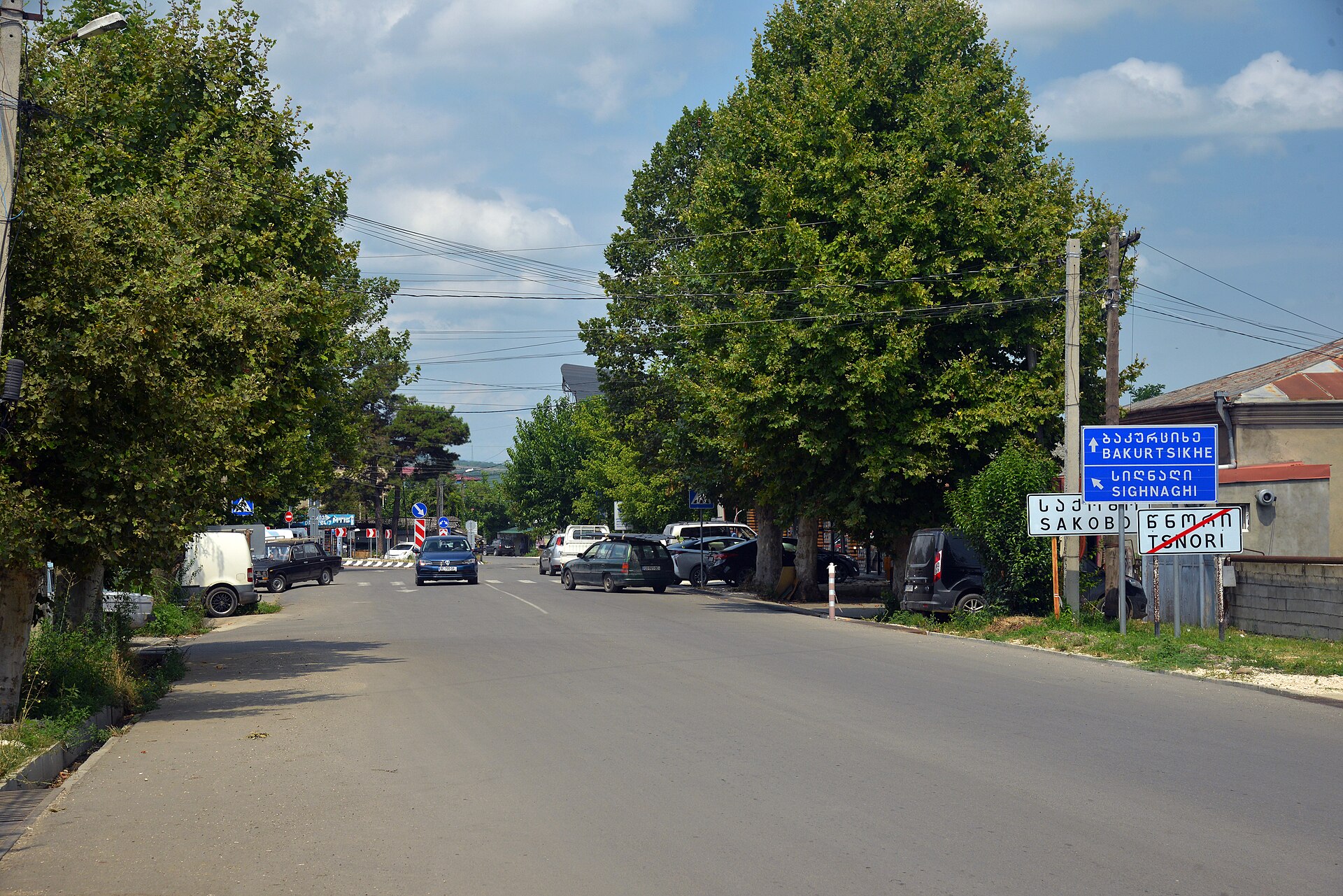
The main road through Tsnori in Kakheti, July 2026. Roads like this one, running straight through villages, are where the gap between the number of crashes and the number of deaths comes from. Photo: Jelger Groeneveld, Wikimedia Commons
The most frequent causes
For every incident the Ministry of Internal Affairs records a probable cause. The table holds the ten most frequent causes in 2025 and the number of deaths for each. One incident may have several causes, so the columns cannot be added up.
| Probable cause | Cases | Killed |
|---|---|---|
| Turning manoeuvre | 1,596 | 117 |
| Crossing into the oncoming lane or breaking overtaking rules | 1,319 | 122 |
| Improper use of a crossing by a pedestrian | 989 | 38 |
| Failure to keep distance | 886 | 52 |
| Exceeding the speed limit | 694 | 114 |
| Driving under the influence of alcohol | 424 | 62 |
| Collision with an obstacle | 382 | 22 |
| Disobeying a sign or road marking | 329 | 8 |
| Breaking intersection rules | 279 | 3 |
| Crossing a double solid line | 170 | 16 |
Speeding ranks fifth by number of cases and third by number of deaths: every 100 such incidents bring 16 deaths. For driving under the influence the figure is 15, for crossing into the oncoming lane 9, for a turning manoeuvre 7. Crashes from the two most frequent causes end in death less often than crashes caused by speeding and alcohol.
Pedestrians are singled out in the evaluation. They accounted for 31% of deaths in 2023, 34.5% in 2024 and 35% in 2025, which is 164 people out of 469. In European Union countries pedestrians made up 17.8% of road deaths in 2024 and 18% in 2025.
The rules today and the plans to 2030
The World Health Organization names five causes behind most road deaths: speeding, driving under the influence, riding without a motorcycle helmet, travelling without a seat belt and carrying a child without a child seat. The organization's 2023 report states that six countries in the world have legislation fully matching best practice on all five. The Ministry of Economy evaluation states that Georgian legislation needs improvement on these points.
Seat belts and child seats
The fine for an unfastened seat belt is set by article 118¹ of the Code of Administrative Offences at 50 GEL, but it applies only to the driver and the front-seat passenger. Passengers in the back are not required to buckle up. There is one exception: under the law "On Road Traffic" a passenger of at least 16 who is holding a child under three must wear a belt.
The Ministry of Economy evaluation cites research on rear seat belts. An unbelted rear passenger raises the driver's chance of dying in a frontal collision by 137% and raises the risk of injury or death for everyone in the car by 40%.
Rules for carrying children are set out in article 26 of the same law. A child under 12 may not be carried in the front seat of a car, on a moped or on a motorcycle. A child under three travels in the back either in a seat matched to height and weight or on the lap of a passenger of at least 16, and no more than one child per lap. For children between three and twelve the law sets no child seat requirement at all. According to WHO data a child seat cuts the chance of a child dying in a crash by an average of 60%, and by 71% for infants.
Amendments on both points are planned in the strategy: mandatory seats for pre-school children first, then enforcement of rear seat belts.
Speed
Speed limits are set by article 33 of the law "On Road Traffic": 60 km/h in a built-up area, 20 km/h in a residential zone, 90 km/h for a car outside built-up areas and 110 km/h on a motorway. On top of those figures comes a tolerance: under article 125 of the Code of Administrative Offences a fine starts at more than 15 km/h over the limit. Going 15–30 km/h over costs 50 GEL, 30–50 km/h over costs 100 GEL and more than 50 km/h over costs 300 GEL. So in town the speed that gets you fined starts at 76 km/h.
It is this tolerance that the strategy proposes to revise. Alongside it come a lower maximum speed in built-up areas, a legal definition of a school zone with a 30 km/h limit, and new cameras on stretches with high crash rates.
A separate point concerns licence points. Every driving licence issued in Georgia carries 100 points: they are credited on 1 January and deducted for offences, and when no points are left the right to drive is terminated. Points are deducted only when a patrol officer writes the report in person. Offences caught by camera cost no points. The strategy provides for extending point deductions to speeding recorded by camera.
Alcohol
Under article 116 of the Code of Administrative Offences, intoxication means more than 0.3 parts per thousand of ethanol in the blood. Between 0.3 and 0.7 the right to drive is suspended for six months; above 0.7, or on refusing a test, for a year. There is no monetary fine for a first offence.
Work on standards for alcohol interlocks is planned in the strategy — devices that stop the engine from starting if the driver's breath is over the limit. So far only the standards are planned, not mandatory fitting.
Novice drivers
Drivers with less than four years of experience account for more than 18% of crashes. A probation period with higher fines and larger point deductions is planned for them.
Requirements for driving schools and instructors are already in force. Under article 60 of the law "On Road Traffic" their rights and duties, their facilities, the way they are supervised and their curricula are set by a separate government decree, and candidates are admitted to the driving test only after a full theoretical and practical course. The strategy plans to bring those rules into line with international practice, naming instructor certification and standardised curricula as separate items. A study will be added to the action plan before the bill is drafted.
What is already in force
Three of the restrictions the strategy talks about already apply in Georgia.
Fines for visible exhaust smoke have applied since 4 September 2023. The fine is set by article 119² of the Code of Administrative Offences and applies in Tbilisi, Batumi, Kutaisi and Rustavi: a driver pays 100 GEL, and a company that put such a car on the road pays 500 GEL. The next offence raises the amounts to 300 and 1,500 GEL, the third to 600 and 3,000. Liability is lifted if within two hours the car is taken to an accredited inspection centre and its emissions are confirmed to be within the norm. Street checks are run by the Department of Environmental Supervision: according to a report by OC Media, ten teams cover the four cities.
Police have been measuring noise since 1 September 2026. An order of the Minister of Internal Affairs sets the procedure for checking with a certified portable device that meets the international standard ISO 5130:2019. Permitted levels are set by a government decree: in built-up areas between 23:00 and 08:00 the noise a vehicle makes must not exceed 80 decibels. The fine under article 118 of the code is 100 GEL and 10 points, then 200 GEL and 20 points, then 300 GEL and 30 points for the third and every further offence. An officer may stop a car for a measurement if there are sufficient grounds to suspect the limit is exceeded; the driver must stop, show documents and not obstruct the measurement. The procedure was published in a statement by the Ministry of Internal Affairs carried by the online newspaper Batumelebi.
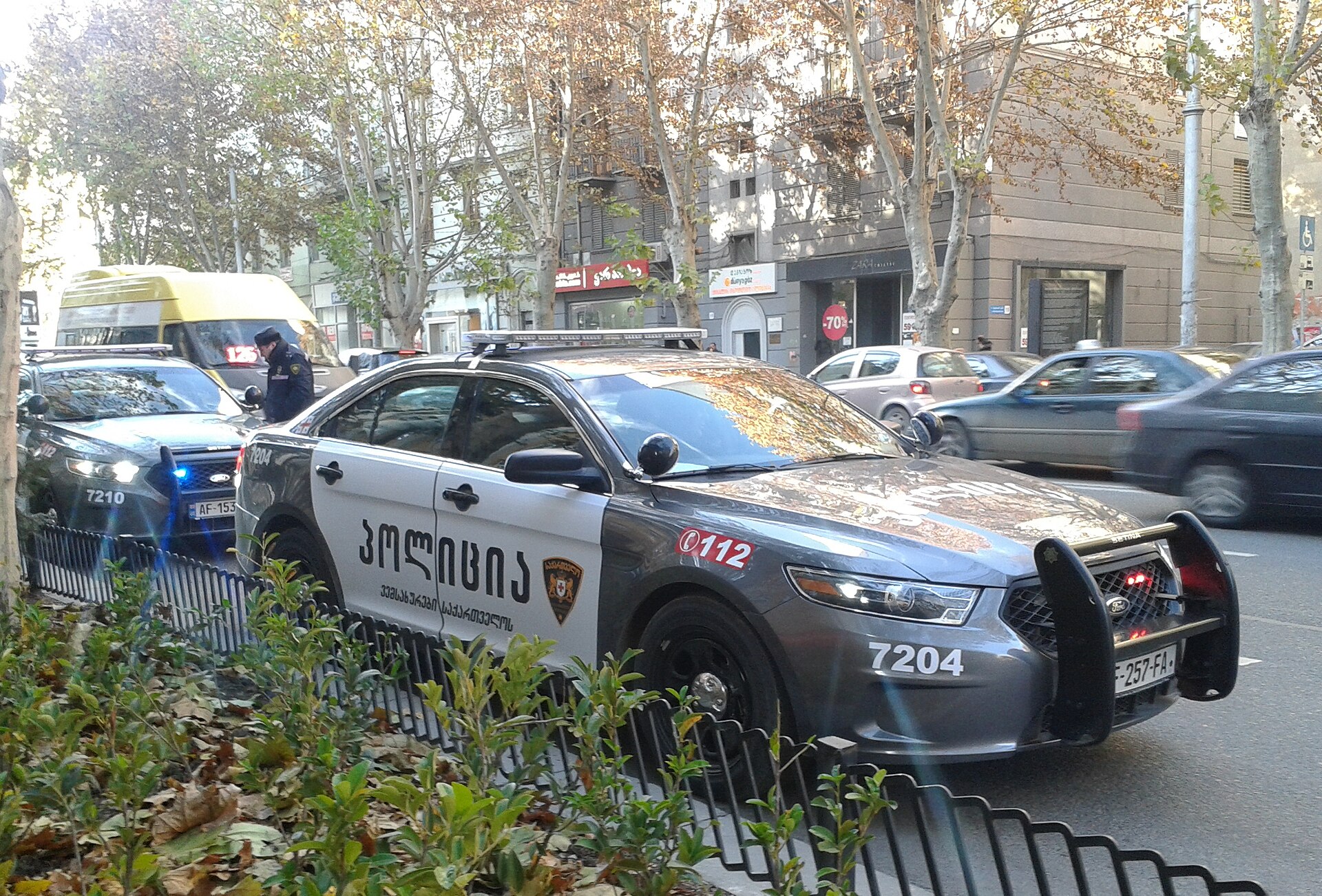
A patrol police car in Tbilisi, December 2014. Noise is measured by the same units that stop cars on the road. Photo: Giorgi Balakhadze, Wikimedia Commons
The camera network has been growing all this time. By the end of 2025 the country had 658 average-speed control sections covering 2,327 kilometres of road, against 861 kilometres in 2019. Cameras with plate recognition made it possible to record offences by cars on foreign plates as well.
How the 2022–2025 strategy ended
The new strategy states a target of cutting deaths and injuries by 25% by 2030. The previous one carried the same target.
The 2022–2025 strategy was approved by government decree №353 of 4 July 2022, and its target was to cut deaths and injuries by 25% by 2025 against 2019. Over four years the number killed fell by 2.5% and the number injured rose by 3.4%.
The Ministry of Economy evaluation sets out why the target was missed. Progress towards it was measured by twelve indicators: the share of action plan measures completed, the number of recorded speeding offences, the number killed and injured through speeding, the number of drink-driving cases, the number of crashes involving powered two-wheelers, the number of injured pedestrians and others. The two action plans held 93 measures in total and were completed to 76.3% against a target of at least 80%.
Targets were fully met on two of the five tasks: vehicle safety and road infrastructure. The number killed per 100 injured fell by 5.8% instead of the 10% planned. The worst-performing task was the one on road user behaviour: two indicators were partly met and four showed deterioration instead of improvement.
The indicators that worsened concern speed and powered two-wheelers. The number of speeding offences per camera rose by 45% instead of the 15% fall planned. In 2025 alone 1,812,977 speeding offences were recorded. The number of people injured through speeding rose by 74.5% and the number killed through it by 48.8%. Crashes involving motorcycles, mopeds and light quad bikes numbered 197 in 2019 and 902 in 2025, but that growth is explained by record-keeping: registration of mopeds and light quad bikes became mandatory only in March 2022, and the number of such vehicles registered grew over that period from 9,398 to 49,048.
Two indicators in the same group improved. Drink-driving cases fell from 29,924 to 26,087. Injured pedestrians fell from 1,773 to 1,572, a drop of 11.3%.
One explanation is given in the evaluation for several indicators at once: between 2019 and 2025 the number of vehicles registered in the country grew by 45.71%, that is by 628,884 cars. What made up that growth is covered in a separate article on the cars of Georgia.
The reasons are described in the evaluation as systemic. Georgia has no single electronic crash database available to all the agencies that work on road safety. Data on crash record cards is inaccurate, the coordinates of the crash site especially. Nor is there software that would use that data to find high-crash stretches automatically. There is no separate budget line for road safety: measures were funded out of the agencies' current administrative resources. No dedicated agency is responsible for road safety either: a road safety department was set up inside the Ministry of Economy in 2024, whereas international practice calls for an independent body with a mandate of its own.
The interagency commission reviewed the draft of the new strategy on 22 July 2026 under the chairmanship of Deputy Minister of Economy Tamar Ioseliani and passed it to a cabinet meeting. The 2026–2027 action plan is costed at 98.9 million GEL. As of 19 September 2026 the text of the strategy has not appeared on the matsne.gov.ge legislative gazette portal, and its contents are known from reports by Georgian outlets quoting the document. The fullest account was published by the outlet Crystalauto on 12 August 2026.
Questions about road safety in Georgia
Is a child seat mandatory in Georgia? For a child under three in the back seat you need either a seat or an adult passenger of at least 16 who holds the child and is belted in. For children between three and twelve the law sets no child seat requirement. A child under twelve may not travel in the front seat.
Do you have to wear a seat belt in the back seat? Under the current rules, no — the fine applies only to the driver and the front passenger. The road safety strategy provides for extending the requirement to the back seats.
How far over the speed limit can you go in Georgia without a fine? A fine starts at more than 15 km/h over the limit. With the urban limit of 60 km/h, fines start at 76 km/h. That tolerance is due to be revised.
What is the blood alcohol limit for a driver in Georgia? Intoxication means more than 0.3 parts per thousand of ethanol in the blood. Between 0.3 and 0.7 the licence is suspended for six months, above 0.7 for a year.
Can you be fined for a loud exhaust in Georgia? You can. Since 1 September 2026 police measure noise with a certified device: going over the limit costs 100 GEL and 10 licence points, a second offence 200 GEL and a third 300. Separately, since 2023 a visible exhaust plume in Tbilisi, Batumi, Kutaisi and Rustavi carries a 100 GEL fine.
Which roads in Georgia are the most dangerous? The most deaths in 2025 were on the roads of Imereti together with Racha and Kvemo Svaneti — 101 people. Tbilisi comes second with 94 and Kakheti third with 60. Kakheti had 2,095 incidents over the year against 39,420 in the capital.
What should you do after a crash in a rental car? Call the patrol police on 112 and do not move the car: moving a vehicle involved in a crash carries a 250 GEL fine under article 123 of the Code of Administrative Offences. The paperwork and the deposit deductions are covered in the article on accidents in a rental car.
What does a car need in winter in Georgia? In certain periods and on certain stretches of road winter tyres are required, and on some passes chains as well. The fine for not having them is 100 GEL. The periods, the stretches and the tyre specifications are covered in the article on winter tyres in Georgia.
There is no need to collect the car from an office: delivery brings it anywhere in Tbilisi in about half an hour and picks it up the same way. You can choose a model in the fleet.
Write to the concierge on WhatsApp or Telegram at +995 557 437 034 or to concierge@autohub.ge, give the model and the dates, and the documents and deposit will be checked before the car is delivered.
Cover photo: the crossroads of Kazbegi Avenue and Kavtaradze Street in Tbilisi, July 2023. Yuri Samoylov, Wikimedia Commons, CC BY-SA 4.0