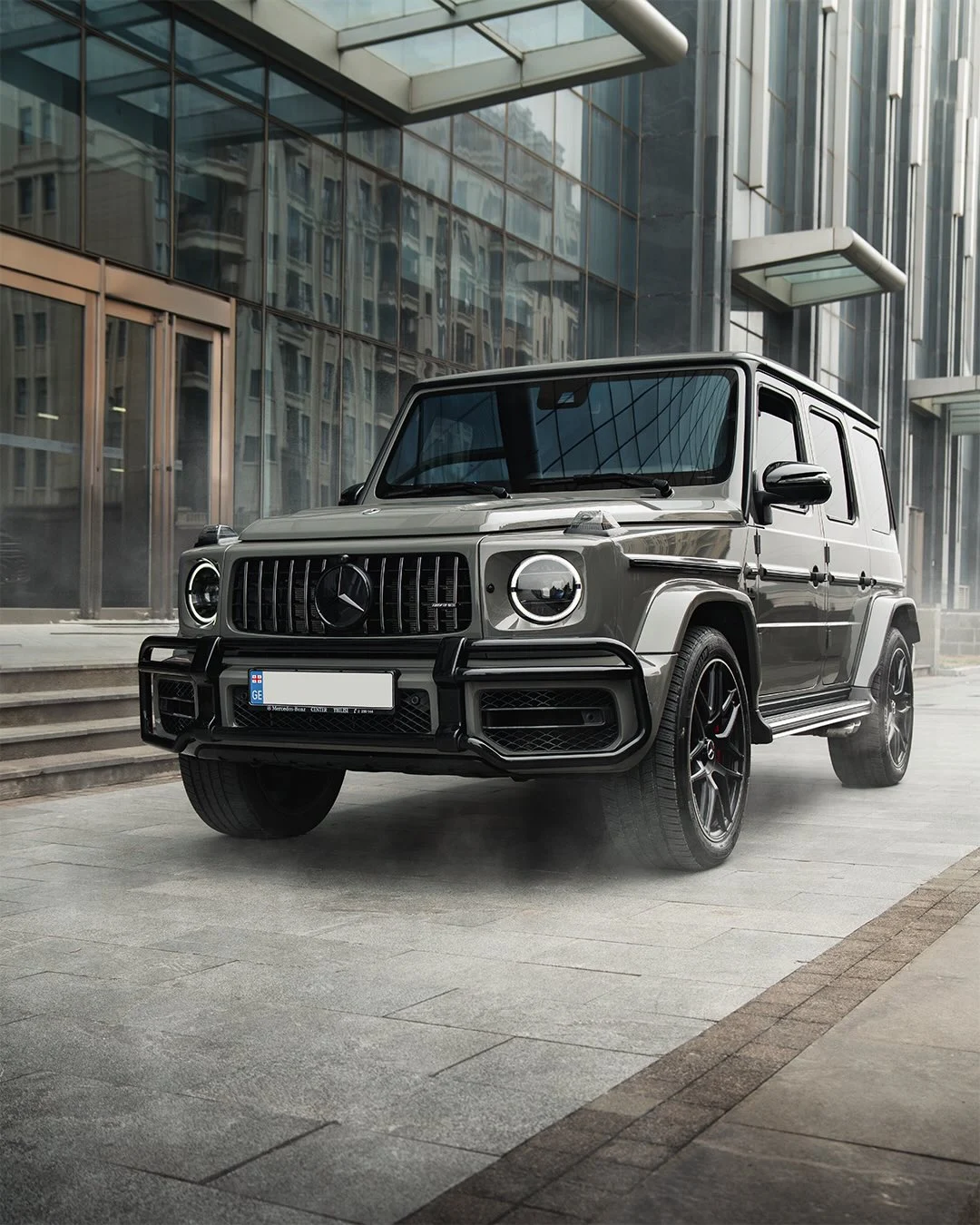
 Alexander wan2ted Evsin
On Fridays, Saturdays and Sundays more than twenty thousand people come to the lot outside Rustavi, and some of the cars they buy are driven on to Baku, Yerevan, Aktau and Bishkek. That is how the work is described on the market's own website.
Cars like these have a line of their own in Georgian foreign trade. They are brought in not to be driven in Georgia but to be sold on and taken out again: that kind of deal is called re-export. Not every car is taken out, though: some stay in the country and go onto the Georgian register.
This article explains in detail how the Rustavi car market works, where its cars are brought from, where they are taken next, and what has changed the flow over the past three years.
What the Rustavi car market is
The lot is on the Tbilisi–Red Bridge highway, the road people take to the Armenian and Azerbaijani borders. On the lot's own website it is called the largest car market in the Caucasus: 225,000 square metres with room for five thousand cars.
It opened in 2009. According to the same website, more than five thousand cars a month are sold there. Cars can be viewed any day of the week; the trading days are Friday, Saturday and Sunday.
A branch of the Service Agency of the Ministry of Internal Affairs works on the market grounds. That means the paperwork can be done without a trip into town: registration, the customs declaration, temporary import, export and re-export.
No import charges are collected on a car bought for resale abroad: it is processed as a re-export. They are paid only by whoever keeps the car in the country: at the border that means excise based on engine size and age, plus duty and VAT. How those sums add up is covered in the article on classic cars.
Where the cars are brought from
In the first half of 2026 Georgia imported 106,278 passenger cars — figures from the National Statistics Office of Georgia. More than three quarters of them were brought in from a single country.
From the United States, 81,646 cars. From Japan, 10,403; from China, 4,338; from Germany, 2,623; from South Korea, 2,112; from Canada, 1,421. Every other country on the list is counted in hundreds of cars or fewer.
Altogether 1.71 billion dollars was paid for the imported cars. Of that sum, 978.1 million went on American cars, 223.9 million on German ones and 222.4 million on Japanese ones. Four times fewer German cars were brought in than Japanese ones, and the same money was paid for them: cars from Germany are the more expensive ones.
Almost all of them are brought in by sea: 101,078 cars out of 106,278. Another 4,952 were brought in across the land borders, 238 by rail, and one car was flown in over the six months.
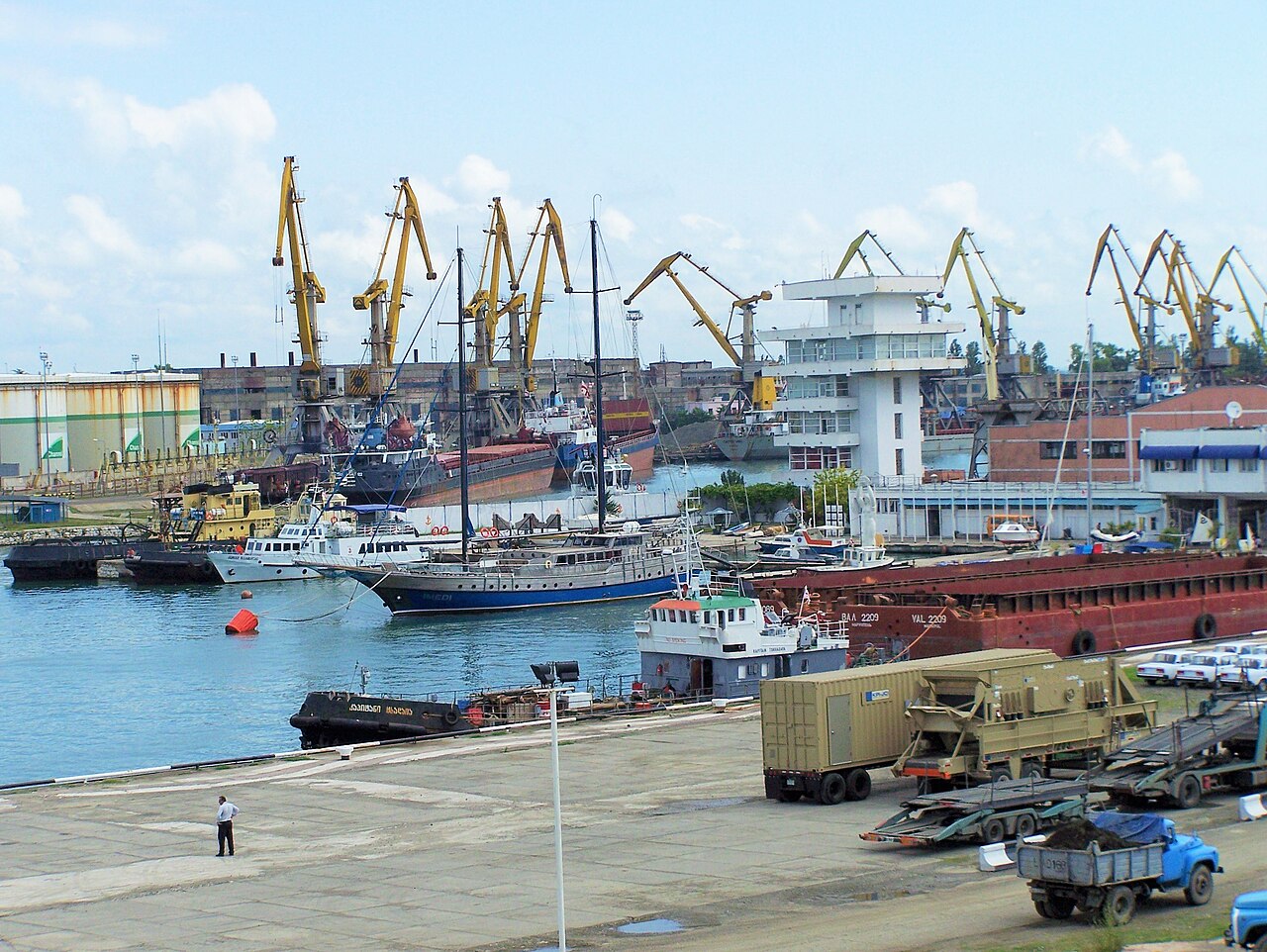
The port of Poti, through which most of the cars are brought into Georgia. Photo: Nc tech3, Wikimedia Commons, CC BY-SA 3.0
Where they are taken next
Over the same six months 38,759 cars worth 938 million dollars were taken back out of Georgia. They no longer go by sea: 37,377 of the 38,759 cars were taken out by road and only 1,382 by sea.
Most of them went to Kazakhstan: 13,068 cars over the six months. Then 10,701 to Kyrgyzstan, 5,086 to Iran, 2,966 to Tajikistan, 2,456 to Azerbaijan and 1,431 to Armenia.
By money the order is different: cars worth 412.8 million dollars went to Kyrgyzstan, 204.4 million to Kazakhstan, 89.3 million to Iran, 82.9 million to Azerbaijan, 49.9 million to Tajikistan and 39.9 million to Armenia. A car re-exported to Kyrgyzstan cost 38,600 dollars on average, one re-exported to Kazakhstan 15,600.
Iran was not on that list before. In the first half of 2025 five cars worth 110,000 dollars were re-exported there; in the same half of 2026, 5,086 cars worth 89.3 million.

The Red Bridge crossing on the Azerbaijani border, 2014. It stands on the same highway as the car market. Photo: Aabdullayev851, Wikimedia Commons, CC BY-SA 4.0
What this means on a national scale
Cars are the single largest item in Georgian exports. In the first half of 2026 cars worth 938 million dollars were taken out of the country, against 487 million for petroleum products, 304 million for precious metal ores and 117 million for wine.
Georgia has no car plants of its own, so car exports and car re-exports are one and the same thing. Both lines in the statistics show the same figure: 938 million dollars.
Below are the first halves of every year from 2019 on: how many cars were taken out of Georgia, for how much, what one car cost on average and what share of all exports they made up.
| Half-year | Cars exported | Value | Average price per car | Share of exports |
|---|---|---|---|---|
| 2019 | 37,927 | $283.4m | $7,473 | 15.8% |
| 2021 | 26,843 | $205.4m | $7,652 | 10.9% |
| 2022 | 29,222 | $269.8m | $9,232 | 10.5% |
| 2023 | 51,013 | $990.9m | $19,424 | 32.5% |
| 2024 | 46,376 | $933.9m | $20,138 | 32.8% |
| 2025 | 49,122 | $1,217.1m | $24,777 | 37.7% |
| 2026 | 38,759 | $938.0m | $24,202 | 24.2% |
What changed the flow
The turning point came in 2023, and it came from sanctions. From 1 August 2023 the Revenue Service of Georgia banned the re-export to Russia and Belarus of cars imported from the United States, and from 26 September of that year of cars from Europe. The ban covers vehicles with engines above 1,900 cubic centimetres and all electric and hybrid cars. The Revenue Service named as the basis the European Union's eleventh sanctions package, adopted on 23 June 2023. That is where the ban on exporting cars to Russia was extended to exactly these categories.
The second measure came a year and a half later. From 15 May 2025 the Service Agency of the Ministry of Internal Affairs stopped processing the re-export of passenger cars and special machinery for Russian and Belarusian citizens, including cases where the car goes to a third country.
Both measures bear on the same route. Kazakhstan and Kyrgyzstan belong with Russia to the Eurasian Economic Union: the union has a single customs territory, and a car is not cleared again at its internal borders. Sergey Tselikov, head of the Russian analytics agency Avtostat, said in December 2025 that a significant share of the cars taken from Georgia to third countries ends up on the Russian market.
The fall landed on those two destinations. Over the half-year 13,068 cars went to Kazakhstan instead of the previous 20,215, and 10,701 to Kyrgyzstan instead of 19,664. In money, re-export to Kyrgyzstan fell from 628.3 to 412.8 million dollars and to Kazakhstan from 353.2 to 204.4 million. The overall share of cars in Georgian exports dropped from 37.7 to 24.2 per cent.
The Statistics Office data give only the country of destination. There is nothing in them about the reason for the fall, but the timing fits: in the first half of 2025 the ban on Russian and Belarusian citizens was in force for six weeks, in the first half of 2026 for all six months.
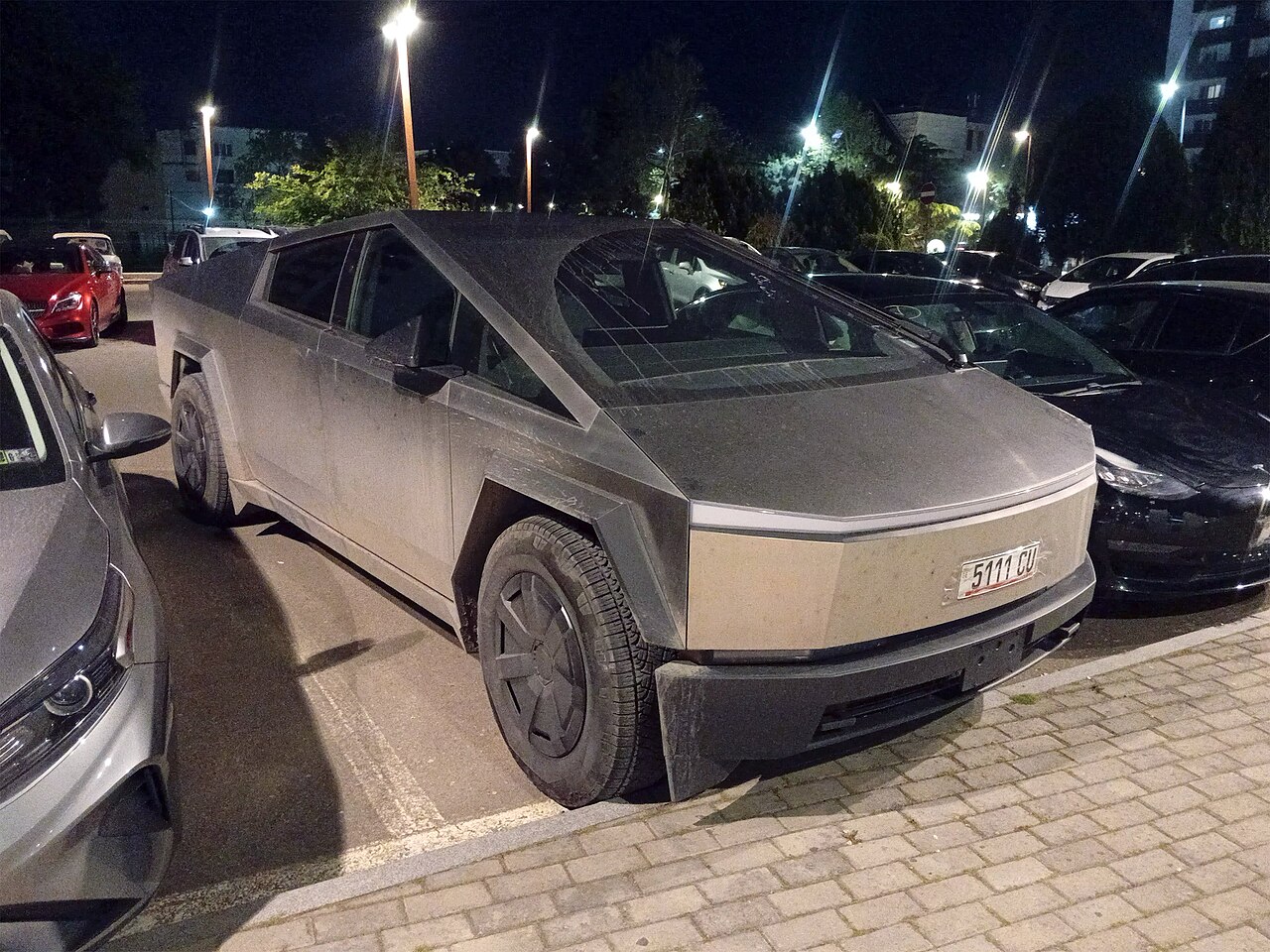
A car on temporary plates in Rustavi. Plates like these are carried by cars not yet on the Georgian register. Photo: Yuri Samoylov, Wikimedia Commons, CC BY-SA 4.0
Questions people ask about the Rustavi car market
Where is the Rustavi car market? On the Tbilisi–Red Bridge highway, on the way to the Azerbaijani border. The nearest city is Rustavi.
Which days is it open? The trading days are Friday, Saturday and Sunday. Cars can be viewed on any day of the week.
How many cars does Georgia send abroad? In the first half of 2026, 38,759 passenger cars worth 938 million dollars.
Why are there so many American cars in Georgia? More than three quarters of the imported cars come from the United States: 81,646 of 106,278 in the first half of 2026. They are brought in by sea, through the ports.
What is re-export? A car is brought into the country not to be driven there but to be sold on abroad. In the statistics such cars form a separate line and do not count as Georgian goods.
Can a foreigner buy a car in Georgia and take it out? Re-export has not been processed for Russian and Belarusian citizens since 15 May 2025. For everyone else the procedure is unchanged: the car is taken off the register and given a transit plate valid for 90 days, which costs 150 lari. More on that in the article on Georgian license plates.
Can I drive to the market in a rental car? Yes. It is less than an hour's drive from Tbilisi along the motorway.
A car does not have to be collected from an office: with delivery it is brought anywhere in Tbilisi in about half an hour and picked up the same way. Models are listed in the fleet.
Message the concierge on WhatsApp or Telegram at +995 557 437 034 or at concierge@autohub.ge, name the model and the dates, and the documents and deposit are checked before the car is delivered.
Cover photo: Tiia Monto, Wikimedia Commons, CC BY-SA 3.0